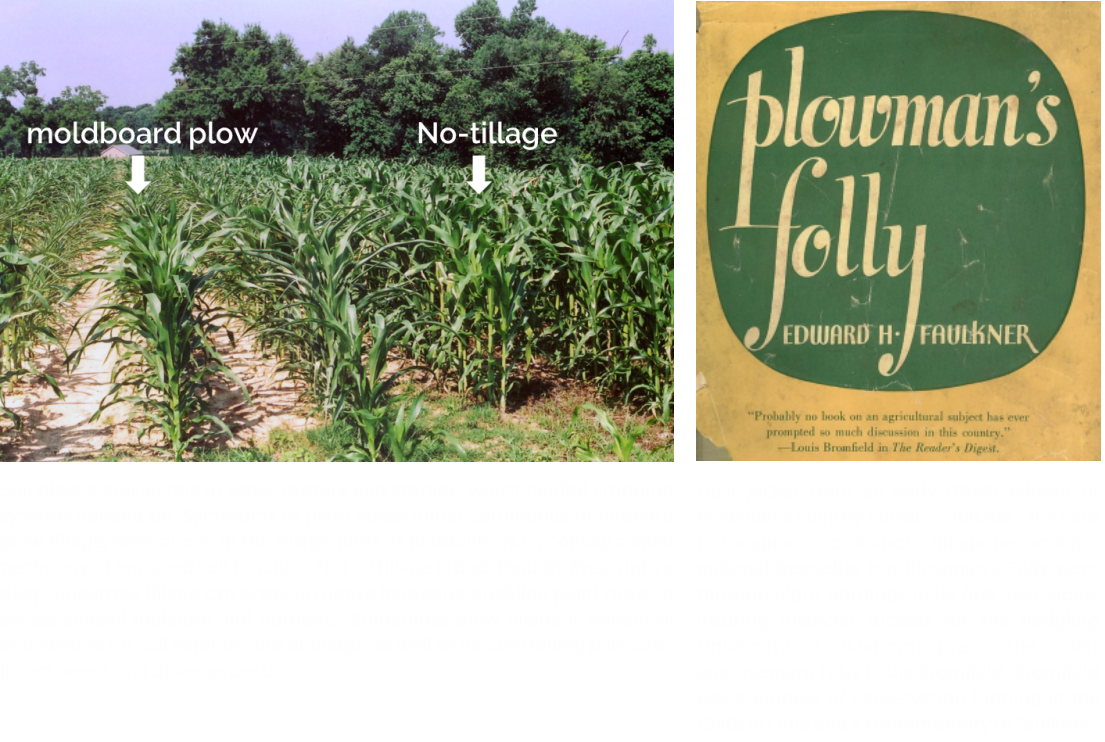
Tillage and Soil Productivity
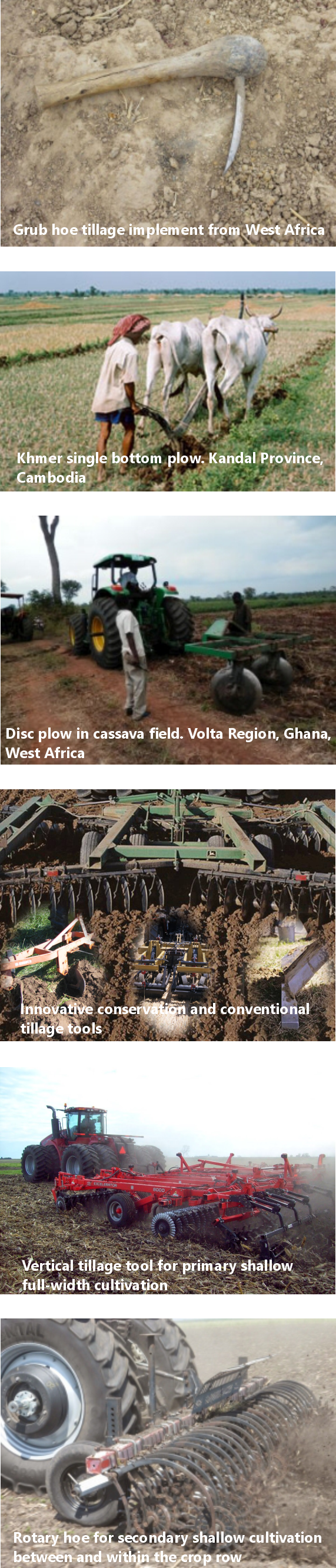
From the earliest hand-powered stone tools used to break ground, tillage has been central to the human relationship with land. The soil retains a memory of tillage, one that may persist for millennia, modulated by texture, structure, drainage, water content, crop rotation, and climate. Because these variables interact in ways that short-term investigations rarely capture, sustained support for long-term field trials is fundamental to understanding the role of tillage in soil function and agricultural productivity.
In 1984, a group of researchers in NCSU’s Department of Soil Science established two agronomy trials, both on fine, kaolinitic, thermic Typic Kanhapludults at the Upper Piedmont Research Station near Reidsville, North Carolina, designed to assess land management practices on soil function, productivity, and environmental stewardship. Eleven research articles have been published in major peer-reviewed scientific journals, and a growing public-private partnership seeks to preserve these unique historic trials in perpetuity. Drawing on this long-term field research, we examine the ways tillage has shaped soil and productivity in Southern agriculture.
- Continuous Conservation and Conventional Tillage in North Carolina’s Piedmont Soil Region: An Appraisal Robert D. Walters, Jeffrey G. White, Joshua L. Heitman, Adam M. Howard, and Michael G. Wagger. ASA-SSSA 2009 presentation.
- Pore Size Distribution and Soil Physical Quality Inferred from Soil Water Retention Curves Robert D. Walters, Jeffrey G. White, Adam Young, Daniel Morris.
- Tillage Effects on Soil Physical Quality Inferred from Indicators and Pore Volume Density Critical Limits Robert D. Walters, Jeffrey G. White, and Michael G. Wagger. Second in a series about novel soil physical quality indicators, such as Dexter’s “S-index,” using information from the soil water retention curve. SSSNC 2014 presentation.
- Tillage Effects on the Distribution of Soil Organic Carbon and Nitrogen in Particle-size Fractions Samba A. Kawa, Michael G. Wagger, and Robert D. Walters. ASA-SSSA 2010 presentation.
- Soil Health: What Does It Mean in North Carolina? NCSU Cooperative Extension. Overview of soil health concepts and indicators relevant to North Carolina agriculture based on tests conducted at Reidsville and other locations in North Carolina.
- Soil Carbon Sequestration And Its Discontents Agrosphere Journal blog 2017. Discussion of soil carbon sequestration under conventional and conservation tillage in relation to climate change mitigation. Features a comparative analysis of long-term (23-yr) soil carbon stocks in the Reidsville agronomy plots. Blog post — under construction, link to be added once blog is transferred from WordPress.