Water Resiliency
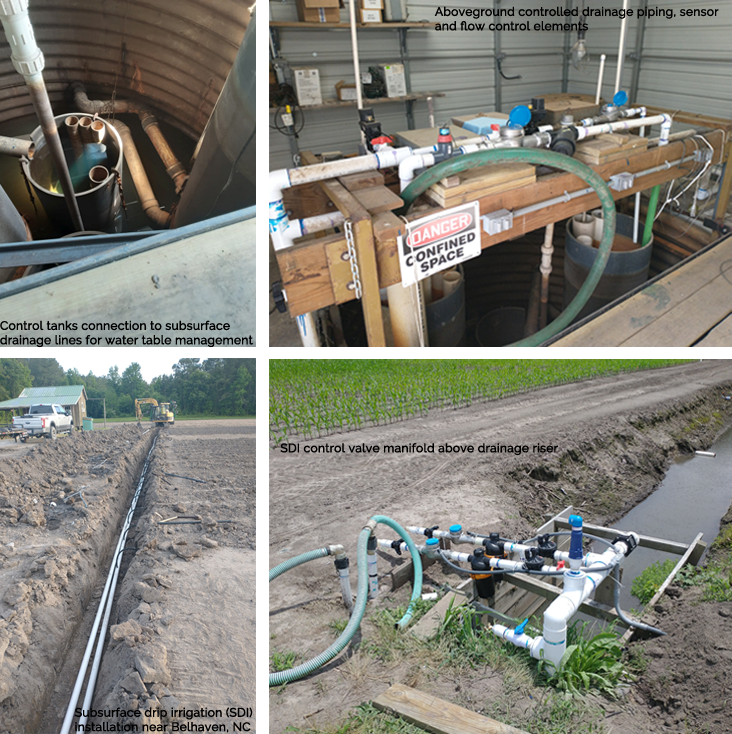
The Water Resiliency Initiative was established in 2020 by the Agricultural Water Management Group within the NCSU Department of Biological and Agricultural Engineering to address the global challenges facing agricultural producers and rural communities, as they compete for that precious, irreplaceable substance —water. Strategically located in the agriculturally rich Blacklands region of North Carolina’s lower coastal plain, the Water Resiliency Initiative consists of two technology validation field sites, one located at the NCDA Tidewater Research Station near Plymouth, N.C., and the other near Bath, N.C., on private land. Both sites are dedicated to evaluating promising new technologies and agronomic strategies to augment water productivity, sustainability, and environmental quality. Through these efforts, we aim to gain insight into the mechanisms driving yield and the components of yield and stress resilience that are favorable for efficient and profitable crop production in climate-vulnerable locales. Identifying crop genotypes that respond positively across environments or are more productive under specific soil and drainage conditions is crucial, given rising input costs. To this end, we are partnering with the North Carolina Cooperative Extension, commodity groups, agribusinesses, and technology developers to match crop genetics, biology, and fertility with site-specific environments.
In addition to stress testing, the Water Resiliency Team conducts soil and groundwater investigations to assess the agricultural and environmental impacts of salinity, a significant threat to coastal communities affected by climate forcing. We are equipped to conduct RTK-assisted surveys for precision land leveling, optimizing surface drainage, and building controlled drainage capacity, enabling producers to increase their return on investment by making informed planting decisions.
Phase Reports
- In The Arena Phase I Report 2021–2023 — See what our team has accomplished over the last three years and key priorities for the future.
Water Resiliency Technical Reports
- 2022 Water Resiliency Corn Report — CPF Agronomics, NC Corn Growers Assoc., NC Cooperative Extension
- 2022 Water Resiliency Soybean Report — CPF Agronomics, NC Corn Growers Assoc., NC Cooperative Extension
- 2023 Water Resiliency Corn Report — CPF Agronomics, NC Corn Growers Assoc., NC Cooperative Extension
- 2023 Water Resiliency Soybean Report — CPF Agronomics, NC Corn Growers Assoc., NC Cooperative Extension
- 2024 Water Resiliency Corn Report — CPF Agronomics, NC Corn Growers Assoc., NC Cooperative Extension
- 2024 Water Resiliency Soybean Report — CPF Agronomics, NC Corn Growers Assoc., NC Cooperative Extension
- 2025 Water Resiliency Corn Report — CPF Agronomics, NC Corn Growers Assoc., NC Cooperative Extension
- 2025 Water Resiliency Soybean Report — CPF Agronomics, NC Corn Growers Assoc., NC Cooperative Extension
Other Resources
- JP Lilley — The Blacklands Soils of North Carolina — The Blacklands are agriculturally important organic and mineral-organic soils in the lower coastal plain of eastern North Carolina. It’s no exaggeration to say that the Blacklands are North Carolina’s “breadbasket.” However, these poorly to very poorly drained soils require special care to remain productive. This technical bulletin, first published in 1981, remains a key reference on the genesis, characteristics, and management of blackland soils.
Ag Water Literacy Publications