Soil, Water and Food Production: A Tale of Two Seasons
Cereal grain production requires two essential ingredients: soil and water. Mineral soil provides the medium for mechanical support and nutrient delivery to plants. Water is essential for plants to acquire essential nutrients and CO2. There is no question that the supply of plant-available water is the primary constraint on food security worldwide.
To drive this point home, consider the following chart:
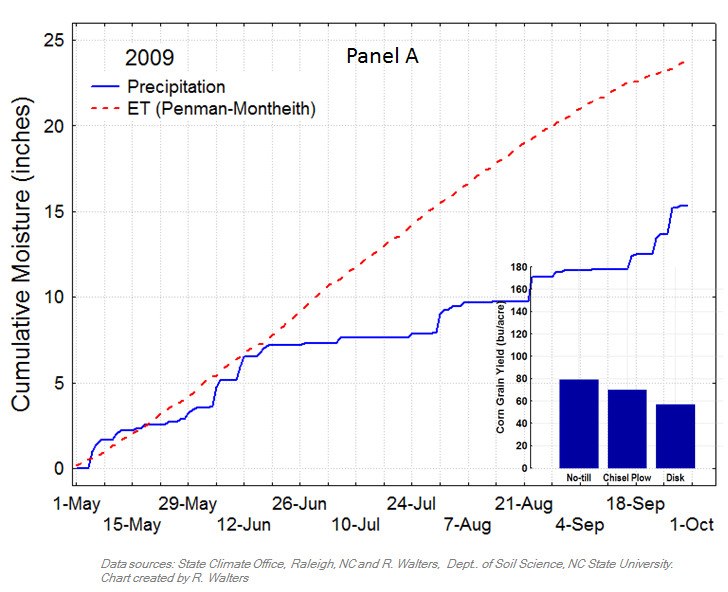
Panel A depicts cumulative precipitation and reference crop evapotranspiration1 (ET) from May to October, recorded at the Upper Piedmont Research Station (UPRS), Reidsville, North Carolina, in 2009. The bar graph in the lower right corner depicts corn grain yield in selected tillage plots at the UPRS, which have been maintained in a corn-soybean rotation by the Department of Soil Science at NC State University for 30 years. Note that ET (red dashed line) and precipitation (solid blue line) are roughly balanced early in the season. However, during the critical June-July corn-growing period (VT ± 10 days), precipitation typically falls well below ET. This is normal across North Carolina’s Piedmont and Coastal Plain. In 2009, corn grain yields, averaged over four replications (15.5% moisture), were 79 bu/ac for no-tillage, compared to 70 and 57 bu/ac for chisel and disk plow systems, respectively. From 1987 to 2013, average corn grain yields for no-tillage was 97 bu/ac, and 83 and 74 bu/ac for chisel plow and disk tillage, respectively. So, 2009 was drier than average, if grain yield is taken as a proxy for the imbalance between precipitation and crop ET during the growing season.
Now witness Panel B:
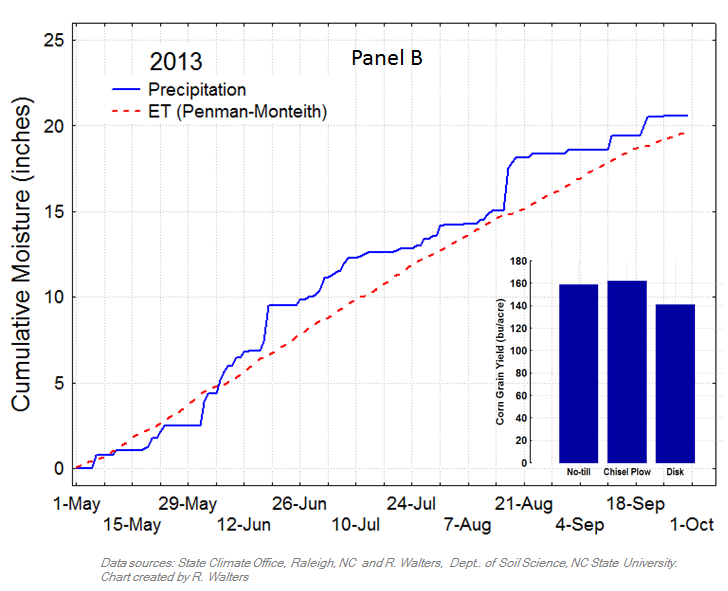
Panel B depicts cumulative precipitation and ET from May to October in 2013. As in 2009, ET and precipitation are roughly balanced early in the season. However, these data show that precipitation exceeded ET for the remainder of the 2013 growing season. It stands to reason that corn growth was not limited by available soil moisture at any time during this period. What effect did this have on corn grain yield? The bar graph in the lower-right corner answers unequivocally: average grain yield under no-tillage was 159 bu/ac, a twofold increase over 2009. Corn grain yields under chisel and disk plow tillage were 162 and 141 bu/ac, 2.3 and 2.5-fold greater, respectively, over 2009. In fact, our K2 grain combine registered over 200 bu/ac in a few plots, a historic level of production never observed at this site.
Three salient points can be distilled from these data.
First: It takes a lot of water to grow corn! The primary pathway for water entering the corn plant is through the root system. Anything limiting root growth invariably limits yield. Soil is the environment in which plant roots grow, and from which plants must obtain 14 of the 17 essential nutrients, including the water required for carbon assimilation. Soil water and plant roots’ access to it are critical features.
Second: Yield differences are greater between seasons than between tillage treatments. In a dry year, conservation tillage systems (no-till, rip, chisel plow) outperform conventional plow tillage (disk, moldboard plow) hands down. If it’s too dry, everything goes south. On the other hand, yield differences are less pronounced in a wet year, as depicted in Panel B.
Now, I can hear midwestern cornhuskers laughing at our pitiful Southern Piedmont grain yields. Let me explain.
About two-thirds of the mapped Piedmont soils in North Carolina are eroded “Typic Kanhapludults”, a ponderous taxonomic epithet for old, weathered mineral soils with strongly developed horizons (horizons are layers, as in a cake). These include the Cecil, Pacolet, Rion, Vance, and Madison named series. The Typic Kanhapludults have sandy to sandy clay loam surface horizons (the “A” horizon or “Ap” if under cultivation to about 8 inches deep) over loamy- to clayey-textured subsoil (the “B” horizon). Unlike Midwest prairie soil developed beneath sod (“Mollisols” or, if you prefer, the “Chernozems” of Russian fame), the Typic Kanhapludults are not endowed with great nutrient and water holding capacity. Micronutrients are often low, so to prevent deficiencies, we lime our soil to a pH of about 6.0, which is considered slightly acidic. Root growth is usually constrained by a strongly acidic pH (<5.0) in the subsoil. So those cut-aways of corn roots extending down 12 feet deep in prairie soils don’t exist here. Despite these handicaps, southern producers have achieved corn yields exceeding 300 bu/ac, but most of this acreage is irrigated and managed well. Yield potential for rainfed corn is primarily dictated by weather and crop genetics. We can’t control the weather, but genetics is something we can tinker with.
Third: Corn has an efficient mechanism for carbon assimilation, known by crop physiologists as “C-4” metabolism. Harnessing cereal and oilseed grain yield potential will require improving water-use efficiency in those crops to capture more carbon in water-limited environments. Our data show incontrovertibly that higher grain yields could be achieved in North Carolina and in similar corn-producing regions worldwide if more water were available during the critical stages of crop growth. The call to breed drought-tolerant crop varieties to improve water-use efficiency and anticipate weather extremes tied to climate forcing has never been more imperative. We therefore strongly urge research into pathways to increase the efficiency of crop water use, recognizing that access to water is key to closing food yield gaps in global cropping systems.
While we don’t anticipate that genetics alone will boost yields by 2x or more, like observed in our tillage plots (other factors like solar radiation, temperature, pest control, mineral nutrition, etc., also drive productivity), a 10% increase in water-use efficiency over current technology would yield a measurable and profitable difference to producers.
Footnotes
1 The reference crop is sod. Actual corn ET may be 20% higher, particularly during critical stages like tasseling and grain filling.