Size Matters (Particle, That Is)
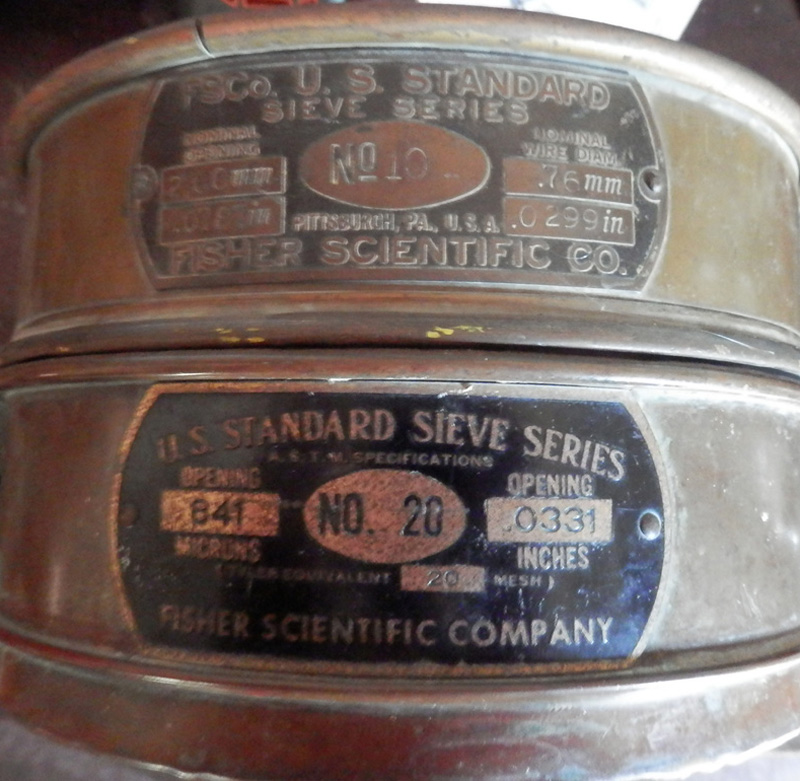
U.S. Standard sieves Nos. 10 (2 mm) and 20 (841 µm). Sieves are used to determine particle-size fractions for material quality, mechanical property evaluation, and classification.
Granted, the last two Agrosphere Journal dispatches were heavy-hitting on the technical side of things. And apologies to all who skipped reading them, which I'm sure is most of you. Now, how about sharing something a little more down-to-earth for a change?
What I had in mind was a recent encounter with that humble, often neglected, yet ever-so-useful soil conditioner: lime. Comes a time in the course of one's daily rounds when something happens to recall a basic truth, self-evident, incontestable, it would seem, yet worthy of relearning. This moment came back to me in November, while applying lime to a field that, according to a certain soil test, had gone quite acid, with a measured pH of 5.3. The same test recommended applying 1 ton/acre of agricultural limestone to bring the pH back to its proper range, mildly acidic 6.0 to 6.2. The telltale moment struck when I realized the hopper on my Gandy drop spreader was running out much faster than it should have, even though it was set to run the last calibration I had marked for this particular brand of pelletized lime. Something wasn't right, so I stopped to investigate.
I didn't notice anything amiss with the lime pellets or applicator. No complicated technology here, just your basic pellets dropping from a slot at the bottom of a hopper in a stream in accordance with Newton's second law at a rate predetermined by manual calibration, hand-written in my field logbook. I know it's considered old school, but I still carry a logbook everywhere I go, even though I could easily store the notes in a Google Drive file and access them from my mobile phone, provided there's cellular service, which is, sadly, not guaranteed anywhere around here. I have field books dating back decades, inscribed with everything from parts serial numbers to seeding and ground-application equipment calibrations, planting and harvesting dates, to measured voltages from long-ago surplus batteries and alternators, both at work and at home. So, it would take no small effort to transcribe every note, and it wouldn't preserve the patina of sweat, dirt and oily grime that embellishes a well-paged field logbook.
Anyway, getting back to the point, the applicator checked out OK, but I still suspected something was wrong because the pellet coating was thicker than usual. I grabbed a sample of lime pellets from the hopper to compare with the others in the cargo container, where my lime and granular fertilizers are stockpiled. The pellets looked identical, but I noticed something else. In the stockpile, there were two brands of lime with similar packaging. We'll call them brand X and brand Y; both are commonly available pelletized lime. At first, I didn't pay attention to this because lime is lime, right?
Wrong! I put a sample of each brand into separate plastic beakers for comparison. Here's what they looked like:
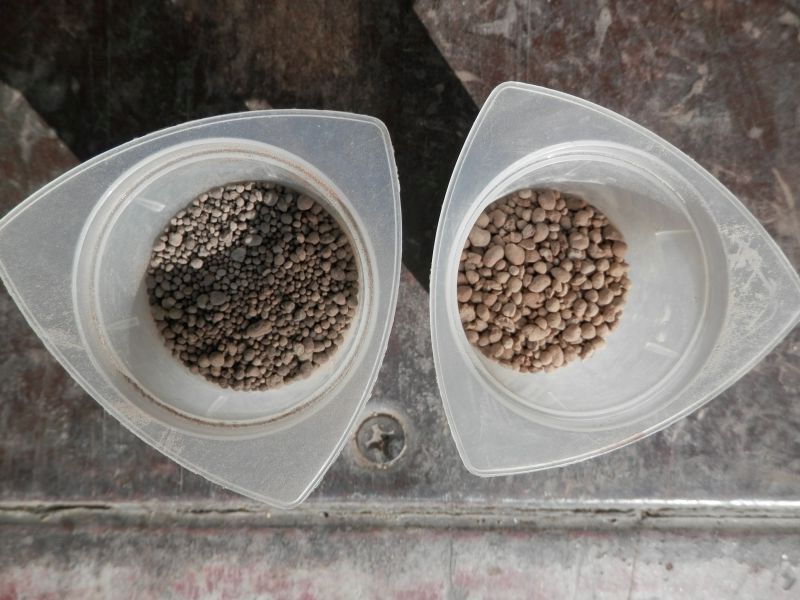
The difference was like night and day! Note the particle sizes of brand X pellets on the left are finer than those of brand Y on the right. Because brand X was finer, it was dropping out at a faster rate than brand Y, the product for which the hopper was gated. That would explain the thicker coating of lime pellets on the ground. How much was the application rate off? After a second calibration with brand X at the same gate setting, it became clear the hopper was delivering lime pellets at more than twice the rate it should have.
In other words, I was applying 2+ tons/acre of pelletized lime.
This was a teaching moment, I thought. As a student in Ag Mechanics 418, I learned about the importance of machinery calibration. This undergraduate engineering course drilled deep into the nitty-gritty of ground application equipment calibration: physics, math, chemistry, et al., in a unified manner that has stood the test of time for me. It also instilled the need for calibrating virtually all measurement instruments, regardless of application. Therefore, I should have known about mixing lime products, but it caught me off guard. Since information about particle size and lime quality must, by government fiat, be printed legibly on the product packaging, I compared the two sieve analyses. Here's how they stacked up:
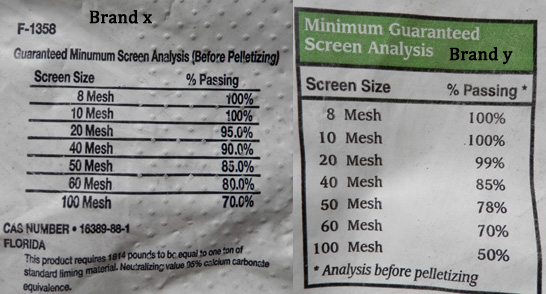
Note that both labels list seven nominal sieve sizes from 8 mesh to 100 mesh. In material mechanical properties analysis, particle size fractions are determined using U.S. Standard Series or Tyler Equivalent sieves. Standard U.S. sieves are designated by number or screen size opening as printed on the packaging labels above. The mesh number indicates the number of openings per unit length: the larger the mesh number, the smaller the opening diameter. Also, note that while the number of screens and nominal diameters are the same, the amount of material passing is not. We observe that the amount of material passing through screen sizes 8 and 10 is the same for both brands: 100%. But the amounts passing through 20, 40, 50, 60, and 100 mesh vary. For brand X, 70% passes through a 100-mesh screen, while only 50% passes for brand Y. Thus, brand X shows a finer distribution of particle sizes than brand Y. The label states that the percentage passing the designated screen sizes was tested before pelletizing. In this sense, it's no different from the sieve analysis of any aglime material. But the end result of agglomeration is that brand X remains finer than brand Y.
Every U.S. state has a procedure for evaluating the quality of aglime, whether pelletized or not, including sieve analysis testing fineness of grind. This information, along with calcium carbonate equivalence (CCE), is used to calculate the effective neutralizing value (ENV). The ENV provides a basis for recommending and adjusting lime application rates, where appropriate. I won't go into how ENV is used to calibrate lime spreaders, but interested readers may review Section 3.5 of Soil Acidity and Liming, for details.
So, the source of my calibration error could be traced back to substituting one pelletized lime product for another that wasn't exactly the same in particle-size distribution. The lesson learned (or re-learned in this case) is simple: don't mix products, and never assume two products are the same just because they're called the same thing in the trade. Product formulations vary with many upstream factors, some of which may be hidden from the end user. If you're using Acme brand granular fertilizer and switch to Co-Op brand, which is a little cheaper this year, you need to recalibrate your applicator for Co-Op, even if it's the same formulation. The two brands may look alike, but there's likely a measurable difference in handling and flowability that will affect application. The same applies to any liquid product, where properties such as concentration, % active ingredient, viscosity, density, and combining ability affect ground application. Always compare product formulations from different origins, even if they're deemed "identical" by regulatory authorities. And check the calibration of ground-application equipment annually, or whenever switching products. Impellers, pumps, gates, and nozzle tips all wear out over time and should be replaced on a regular schedule. Even the wire-mesh openings on a U.S. Standard sieve grow larger over time from constant abrasion.
In the end, my calibration mishap didn't cost much and probably won't change the soil pH drastically since it only affected a relatively small area. Disking and field conditioning should further dilute the carbonates in the affected zone. But for broadacre operations, poorly calibrated equipment can yield a substantial waste of money, damage crops, and risk polluting our soil and water. Basic human-machine interactions, such as calibration, still contribute significantly to agricultural efficiency, productivity, and environmental protection. Can your satellite imagery do that?