Pseudocereals: Super “Foods”, or Pantry Hokum?
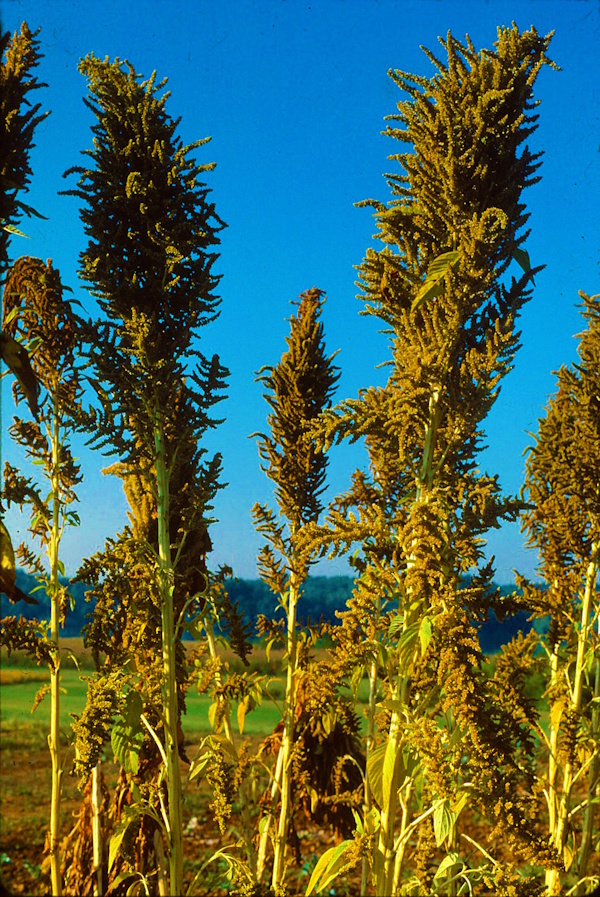
Amaranthus cruentus, a grain-type amaranth growing in Tennessee, USA. Image source: Walters Collection.
Move over, wheat, rice, barley, and maize: Your botanical impostors are poised for global conquest! The pseudocereals are on the march and they’re going viral, particularly among North American culinary savants and health-conscious types. Even the Food and Agriculture Organization of the United Nations (FAO), to focus attention on underexploited genetic resources for developing countries, designated 2013 the “International Year of quinoa” a pseudocereal. But what exactly are pseudocereals, and why all the ballyhoo over them?
The term “pseudocereal” refers to a class of cosmopolitan grain-like plants, including old standbys like buckwheat (Fagopyrum esculentum), and not-so-familiar plants like quinoa (Chenopodium quinoa), kañiwa (Chenopodium pallidacuale), amaranth (Amaranthus spp.), huazontle (Chenopodium nuttaliae), and chia (Salvia hispanica). True cereals are monocotyledon (one seed leaf) plants, all members of the grass family Poaceae, in botany lingo. Corn, wheat, oats, and sorghum are familiar monocot grass plants. Pseudocereals, in turn, are dicotyledon (two-seeded leaves) broadleaf plants. The so-called “dicots” are a large, diverse group of flowering plants that include food mainstays such as cucumber and potato, and oilseeds such as soybeans and canola, among many others.
Pseudocereals like quinoa, chia, and amaranth have surged in popularity because their seeds are nutritious, offering a favorable balance of amino acids, health-promoting omega-3 fatty acids, dietary fiber, and minerals, or a combination of these. Pseudocereals also earn bonus points for being gluten-free, a food preference on the increase. Quinoa production has jumped since 2008 in the core Andean producing countries of Bolivia, Ecuador, and Peru (Figure 1). Quinoa exports from the region have also taken off, fueled by demand in Europe and North America, where the grain has acquired a haute cuisine status as a superfood with life-extending, health-promoting virtues. Comparisons to meat have been made. As such, there’s concern that the boom in quinoa’s popularity is depleting domestic supplies in exporting countries.
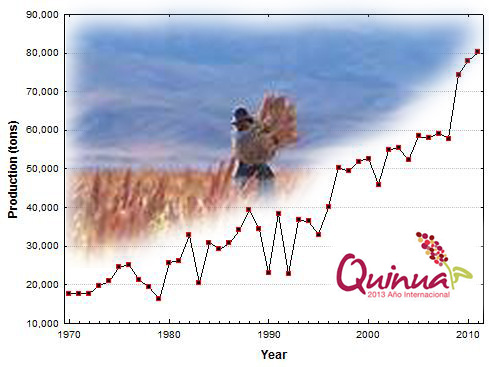
Figure 1. Quinoa production 1970-2011 from Bolivia, Ecuador, and Peru. Data source: FAOSTAT (2011). Graphic: R. Walters.
Naturally, curious (and skeptical) minds want to know: Do these upstart grains deserve the commercial hype? Are they super “foods”, or just pantry “hokum”?
To answer this question, Agrosphere Journal’s dedicated Acme Scientific Research Collaborative® surveyed the global literature on pseudocereals, covering their history, botany, and nutritional value in the human diet. The first installment examines quinoa and allies, available here. Aspects of grain protein quality are emphasized since this seems to be the hallmark of quinoa’s nutritional aura. Warning: this 13-page report is an advanced treatment of nutrition and food chemistry with citations from professional journals, many of which exist behind paywalls. The report delves into amino acids, amino acid profiles, scoring patterns, PDCAAS, fatty acids, fiber, vitamins, and minerals. As a long-form piece, it’s not well-suited to the blogger platform. Therefore, it has been placed in a GitHub repository, accessible via the link above, rather than reproduced here. If you’re looking for a science-informed assessment of the mob of nutritional claims about the pseudocereals, this piece is an excellent starting point.
The pseudocereals may seem far removed from my current preoccupation with irrigation and drainage, but in fact, the subject is near and dear to my heart. Back in the dark ages of the 1980s in what seems like another lifetime — or more precisely an offshoot from a highly non-linear career — I tested amaranth grain and leaf protein content response to soil nitrogen application. Later, I field-tested the first generation of “Roundup Ready” soybean transgenics. The fate of transgenics in the last decade has become closely linked to that of amaranths, particularly Palmer amaranth (Amaranthus palmeri), owing to the species’ acquired resistance to the herbicide glyphosate. Which is just another way of saying nature, perhaps the universe itself, is one big sloppy enchilada. Take a bite, but not too much!
Are pseudocereals like quinoa a regular part of your diet? What is their perceived value above and beyond other cereal and oilseed grains? We’d like to know!