Peasants, Farmers and Scientists
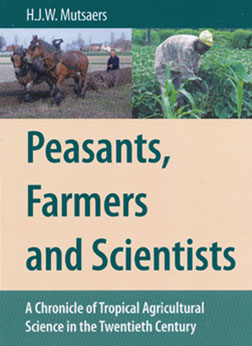
Ever hear of farming systems research, training and visit, and participatory rural appraisal? If so, chances are you’re a veteran of the 1970s and 80s era war on food insecurity, then blitzing across the African continent. This war had no generals, shock troops, enfilades, pincer movements, or Maginot line to defend. No hearts and minds to spar over. As Henk J.W. Mutsaers recalls, the battle played out in the rarefied confines of elite international research centers, extension bunkers, and donor silos, edging into the tactical embrace of consultants and purveyors of development aid, armed with infectious goodwill and an appetite for money. Its Waterloo moment came in the late 1990s, when the patience of the World Bank, the IMF, and bilateral and philanthropic entities had been tested enough to cut the cord and move on. Now, as ever, Africa’s production of cereal grains is placed at the bottom of global rankings, and food deficits in many countries are still endemic. What went wrong?
If the name H.J.W. Mutsaers doesn’t ring a bell, he’s a Dutch agronomist, crop modeling enthusiast, and author of Peasants, Farmers and Scientists: A Chronicle of Tropical Agricultural Science in the Twentieth Century (Springer, 2007). Part history, autobiography, and technical monograph, Peasants, Farmers and Scientists tells the story of tropical agricultural science and agricultural development from the beginning of the 20th century, an era of colonial rubber, oil palm, and sugar plantations that beckoned cavalier European agronomists like Henk Mustaers. The book’s eleven chapters, nine appendices, and expansive bibliography dish up, on a non-trivial yet comprehensible level, the evolution of tropical agriculture science from colonial handmaiden to development agent, focusing primarily on the interplay of donors, scientists (local and foreign), research centers, and farmers in West and Central Africa in the second, post-colonial half of the century. On exhibit are field notes, disputations, and scientific gleanings from the author’s far-flung gigs as researcher in the Dutch East Indies (now Indonesia); lecturer at Wageningen Agricultural University in the Netherlands and at the Ecole Nationale Supérieure Agronomique (ENSA), near Yaoundé, Cameroon1; researcher at the International Institute of Tropical Agriculture in Ibadan, Nigeria, West Africa; and lately, freelance consultant.
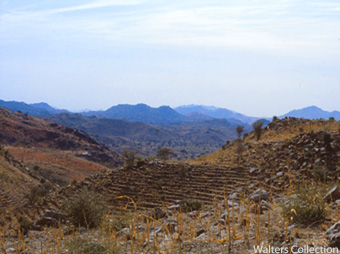
Figure 1. Native stone terraces in the Mandara Mountains, northern Cameroon. The terraces capture rainfall during the brief rainy season, improving water infiltration and conserving soil. Sorghum and millet are the principal crops in this semi-arid zone. (Image: Walters Collection)
For the uninitiated, you’ll learn the nitty-gritty of shifting cultivation (“the mother of all systems”), sugarcane breeding, clever indigenous farming practices, experimental smallholder technologies, crop modeling (of course), innovative methods for evaluating technology in farmers’ fields, and agro nutrient budgets. Astonishing practices like “écobuage”, described anecdotally in Chapter 5, “Forests, Fallows and Fields,” as a method of slowly burning grass residue in soil trenches under low-oxygen conditions in western Cameroon, anticipate the concept of pyrolysis for biochar production. In Nigeria, there’s an ingenious Yoruba maize-sorghum-yam rotation that modern agroecologists would have a hard time improving on; native soil- and moisture-conserving stone terraces in the Mandara Mountains of northern Cameroon (Figure 1); and the obscure “van der Meulen” method of speargrass (Imperata cylindrica) suppression and soil rejuvenation that exploited the peculiar habits of two legumes, velvet bean (Mucuna pruriens) and Centrosema, and a deep-rooted invasive Eupatorium species (Chromolaena odorata), to further whet your appetite. Since my blogging time is limited to after-hours and weekend punting, and the attention span of online readers is abridged, I’ll limit my comments to a couple of resonant themes in Peasants, Farmers and Scientists about African agriculture, to which I can add substance.
The first theme turns on this question: Can a modern market-centered African agriculture evolve from its peasant roots, or will this require a completely different mindset? At one time, Mutsaers believed that Africa’s peasant farmers could transition to a market-based system if alternatives to slash-and-burn were found. This view is embedded in the idea that the traditional subsistence farmer is a rational operator, or at least what we consider rational in a post-subsistence, modern agribusiness world. The idea is that improved genetics, fertilizers, lime, nitrogen-fixing legumes, and other inputs should increase returns to labor and land, fostering the transition to a market-centered enterprise.
Ah, but the picture has always been (and still is) much more complicated than that. Technologies like no-tillage planting failed to take root in sub-Saharan Africa, only to blossom in Southern Africa, North and South America. Promising non-mechanized “appropriate” technologies aimed squarely at resource-limited smallholders have also fallen flat. Take alley cropping, for example. Briefly, alley cropping is a method of planting annual crops between rows of perennial trees, especially fast-growing multipurpose nitrogen-fixing species such as white lead tree (Leucaena leucocephala), Erythrina (Erythrina poeppigiana), and Gliricidia (Gliricidia sepium) (Figures 2a and 2b).
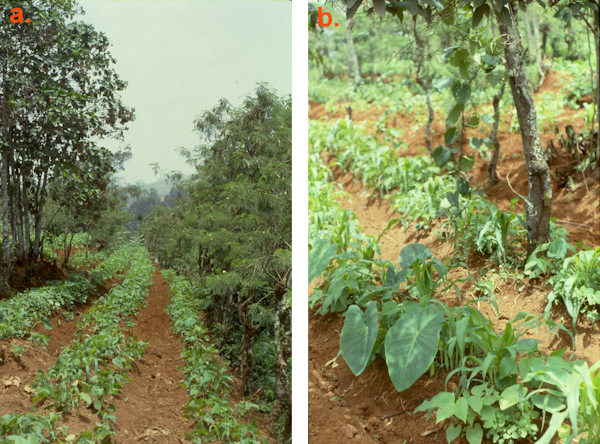
Figure 2. (a) Alley cropping in the highlands of western Cameroon. Note the large unpruned perennial trees. Perennials furnish green manure, but they can also compete aggressively with food crops for moisture and nutrients. (b) Raised beds planted with maize, beans, and cocoyam. Intercropping is favored by peasant-farmers in Africa, but agronomists prefer monocropping because a single crop facilitates modern management practices. (Image: Walters Collection)
A typical alley cropping scenario involves intercropping maize with root crops (sweet potato, cassava, cocoyam) or cowpea, or a combination of these, in succession between trees planted about 4 meters apart. The trees are pruned to small hedges at the start of the growing season, and perhaps once or twice thereafter, with trimmings placed in the alleys as “green” manure. The concept of green manuring dates back to antiquity: Roman agricultural writer Varro (116 – 27 BC) advised plowing under legumes such as beans and lupines in their green, unripe state to improve the soil. Cato, Columella, and Pliny gave similar advice. Alley cropping updates the green manure concept to include woody perennial species.
Popularized by B.T. Kang, G.F. Wilson, and colleagues at the International Institute of Tropical Agriculture (IITA) in Ibadan, Nigeria, alley cropping aimed to mimic elements of traditional slash-and-burn agriculture, in which trees are cut down while leaving the roots intact. After a period of cropping, the tree stumps resume their growth. Competition from sprouting trees and weeds, coupled with soil nutrient depletion, prompted the traditional slash-and-burn farmer to seek new ground every 2-3 years. Thus, the term “shifting cultivation” arose. Alley cropping short-circuited this endlessly itinerant slash-and-burn cycle by planting, purposefully, deep-rooted perennial trees to capture nutrients that leach down beneath shallow-rooted annual food crops. The dodgy nutrients are returned to the surface in the tree’s vegetative parts, fortified with minerals from the subsoil. Tree trimmings are mixed into the soil, where they decompose, releasing plant-essential nutrients and leaving behind a residue of humus. To facilitate farm operations, trees were planted in straight lines, leaving the spaces open for mechanized cultivation where feasible. Superficially, alley cropping appears to be the perfect, sustainable, and eco-friendly alternative to slash-and-burn.
As it turned out, alley cropping was not the perfect solution. Mutsaers parses the quantitative details in Appendix 4 “Nutrient Dynamics of Alley Cropping: A Simple Model”, for agronomists are also ruthless nit-picking scientists who are never satisfied until the numbers add up in the biophysical balance of accounts. If you steal from Peter to pay Paul, you eventually bump up against a form of biophysical entropy, aka diminishing returns. Crop and soil modeling is an excellent way to test this principle by predicting how the system will react to the ebb and flow of energy and nutrients. To my knowledge, this is the first attempt to simulate long-term productivity under alley cropping in the humid tropical forest zone. Indeed, even Musaers voiced surprise that it had never been done after so many years of alley cropping research.
If Mutsaers’s soil and plant nutrient allowances are taken as reasonable approximations, and the assumptions about system productivity are met, his simple model predicts that even on a favorable site with “good” soil, continuous maize-cassava and maize-cowpea alley cropping would be impossible in the long run without supplemental fertilizer. The demand for nutrients needed to sustain continuous cropping was predicted to outstrip available stocks even in the subsoil. As the soil’s nutrient stocks are siphoned off in food products, the production of tree trimmings eventually declines to a point where the system collapses under the strain of nutrient exhaustion. Mutsaers concludes, rightly, that alley cropping is a form of soil mining, especially the macronutrients phosphorus and potassium (calcium, magnesium, sulfur, and micronutrients were not included in the models). The model predictions were validated by measured crop yields from two 12-year alley cropping experiments in Nigeria, one with non-fertilized maize and cassava, reported by Tian et al. (2003; 2005), and a maize-cowpea system with fertilizer phosphorus and potassium, reported by Kang et al. (1999). Mutsaers admits taking some liberties in making assumptions about soil and plant processes in his alley cropping simulations, which may not extend to other soils and agroecological zones. One could quibble over his choice of 10 parts per million as a critical available soil phosphorus (P) level for maize production, which seems on the low side, but this depends on the type of extractant used to measure soil P and other factors like soil texture, nitrogen uptake, and capacity for P-immobilization.
Not coincidentally, a similar picture emerged from research by L.T. Szott, C.A. Palm, and P.A. Sanchez (1991) following a series of alley cropping trials in the Peruvian Amazon with upland rice and cowpea (Figures 3a and 3b).
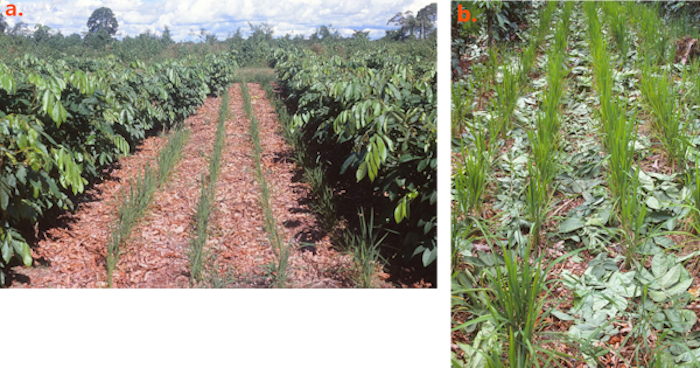
Figure 3. (a) Alley cropping experiments in the Peruvian Amazon with upland rice flanked by perennial ice-cream bean (Inga edulis). Note the straight lines and uniform spacing of rice plants in the middle and the uniform distribution of Inga trimmings in (b). Controlled experiments like these were (and still are) the rule on agricultural research stations in the tropics, yet they failed to replicate the haphazard conditions of farmers' fields. (Image: NCSU Soil Science)
While it’s impossible to relate all of the details here, Szott and coworkers concluded that even with legumes pruned as hedges or as the principal crop, or both, continuous alley cropping was not sustainable on acid, infertile Amazonian soils without nutrient subsidies from outside the system. In other words, alley cropping failed to measure up in two distinct agroecological zones in Africa and South America. In the end, however, the promise of alley cropping did not fail due to nutrient exhaustion, as predicted by Mutsaers’ crop-soil models and borne out by multiple field trials in West Africa and Peru. The main problem was that farmers did not want to adopt alley cropping, a separate conundrum I’ll try to unpack.
The concept of technology transfer is deeply embedded in every implementation of agricultural development. Nowadays, it’s more avant-garde to speak of “value chains,” but this is just a purloined buzzword that alienates donor-side bureaucrats from the untidy prospect of intervening in agricultural production systems. In the loosely defined putative research-extension alliance, technology is generated by scientists. The products are then disseminated by specialists schooled in the donor “recipients’” repertoire, in this case, peasant farmers. In principle, the spread of improved technology to rural producers is facilitated by public agencies, acting alone or in concert with international organizations. It’s a simplistic approach with many pitfalls. Perhaps its biggest flaw was the assumption that the priorities of public agencies, international organizations, and rural producers were mutually aligned. This was rarely the case. Thus, agronomists could push out novelties like alley cropping even though labor demand, access to inputs, land tenure, and other fixtures of peasant-farmers’ lives made no sense for them to change what they were already doing, except perhaps in exchange for free donor-supplied goodies while they lasted. Mutsaers concedes that this was a major obstacle to disseminating improved practices from the research stations. There were other lurking pitfalls too, from unexpected quarters. Let me elaborate on the “lurking pitfalls” from my trench-level experiences with cassava and rice in Sierra Leone.
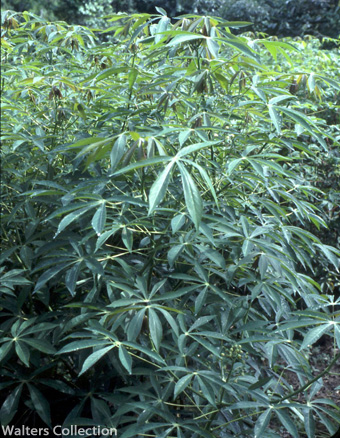
Figure 4. Mosaic-resistant cassava growing in the author's multiplication nursery. Locals were unenthused by it.
Cassava (Manihot esculenta) is a traditional root crop in Africa, though it is scarcely known outside its native tropical habitat. As Mutsaers points out, cassava is alien to Africa; the plant was, in fact, introduced there from Brazil by Portuguese traders in the 16th century. Cassava is a tough plant that tolerates uncertain rainfall and marginal soil, two complementary virtues that have earned it the nickname “bread of the tropics”. One of cassava’s weak spots is its susceptibility to the African cassava mosaic virus, first reported from East Africa in 1894. Viral epidemics have severely affected cassava production, resulting in significant economic losses and, in some cases, famine. In the 1970s, high priority was given to breeding mosaic-resistant cassava. Scientists at the IITA in Nigeria achieved this by drawing on parent varieties developed earlier, through crossing M. esculenta with virus-resistant tree cassava (Manihot glaziovii), believed to be a natural hybrid of Ceara rubber and cassava species at the Amani research station in East Africa (the breeding process is much more complex than simply crossing two species, but I leave out the exact details). Back then, I was given some virus-resistant cassava “sticks”, as the vegetative stem cuttings are known, and advised to propagate them and give the offspring to farmers (Figure 4).
In theory, this was a good idea. In practice, it proved less redeeming. While the virus-free cassava increased beautifully, it wasn’t a hit with the locals. Breeding resistance to the cassava mosaic virus, it seems, also thickened the cassava leaf epidermis. Perhaps this was by design because the leaf-feeding whitefly is the principal vector of cassava mosaic (other anatomical and/or phytochemical traits may also have been affected; the exact resistance mechanism is unknown to me). In the event, the culinary properties of the virus-resistant cassava leaf were noticeably altered. Farmers complained that it wasn’t “sweet” like the native varieties. I should point out that eating cassava leaves was almost a daily ritual in Sierra Leone, so local preference may have steered people’s reactions. Over time I, too, had acquired a taste for the native leaf, and even this puumui could tell the virus-free cassava was inferior!
Similar resistance was encountered trying to disseminate improved japonica rice varieties bred at the International Rice Research Institute (IRRI) in the Philippines, which were increased locally by the West African Rice Development Association (WARDA). The IRRI varieties grew beautifully with fertilizer and controlled irrigation but lacked the fluffy texture and sweet flavor of native Mende upland “red” rice (Oryza glabberima) produced under traditional slash-and-burn cultivation (Figure 5). Swamp rice was a tough sell to slash-and-burn farmers, as were environmental controls like irrigation, seedling nurseries, and line-planting with sticks and string. Of course, fertilizer was out of the question for most farmers, so it was natural for them to favor native rice varieties better adapted to Sierra Leone’s acid, infertile upland soils, despite their generally low grain yields. But why did agronomists ignore upland rice? Breeding programs for upland rice did not exist in Sierra Leone, nor were there initiatives to stabilize upland production systems2. The answer lay in the swamps, and the battle cry was “Develop them!”
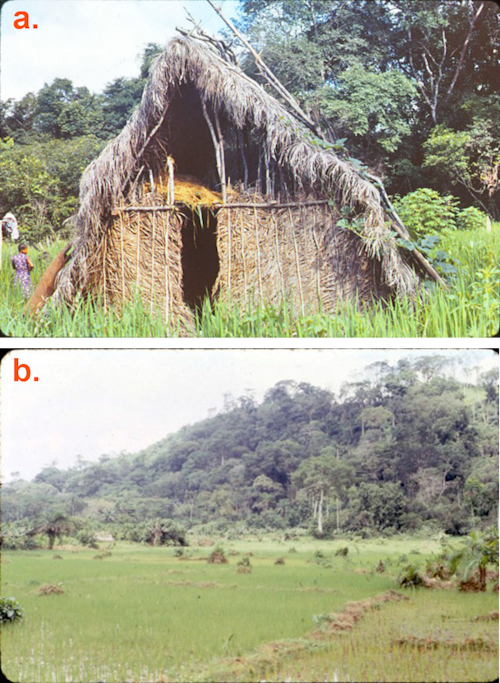
Figure 5. (a) Traditional slash-and-burn farm in Sierra Leone. The tall grass surrounding the farmhouse is upland rice. (b) Typical inland valley rice farm near Kenema, Sierra Leone. Hazards like schistosomiasis and river blindness were a constant risk to farmers working these swampy lands. (Image: Walters Collection)
What does this say about the African peasant farmer’s capacity for change? Henk Mutsaers confesses that he’s had second thoughts about the idea of re-wiring the traditional peasant farmer for the future. Commercial, market-centered farming in Africa may require a completely different mindset that can only be gestated de novo rather than inoculated through participatory rural appraisal, training, and visit conferences. Indeed, there are signs of a new entrepreneurial vanguard in the ascendant peri-urban farming movement, a global trend taking its lead from a sophisticated reading of urban markets and demographics. Curiously, Mutsaers is silent about the ever-expanding Chinese footprint in Africa, a phenomenon observed for over two decades and bound to alienate African agriculture and markets. Of course, the Chinese are certainly not the only players in the global land grab; perusal of the Oakland Institute’s Understanding Land Investment Deals in Africa indicates a diverse mix of public and private stakeholders. In the event, the verdict is still out on the transglobal farming model. If carefully implemented and managed, vertically integrated “international” farming may contribute to the long-awaited green revolution in Africa. On the other hand, I don’t see why farmers must conform to any particular mold. Why can’t African farmers be traditional and market-centered, or a mixture of both? After all, there are greater extremes coexisting in the industrialized West: artisan modes of production, such as organic and specialty farm-to-table operations, in the shadow of industrial mega-farms in the Midwestern USA. I think there’s room for everyone’s persuasion.
Returning to the subject of technology transfer, the failure of farming systems research (FSR) and other donor-inspired fads in Africa gives one pause to contemplate the legacy of foreign intervention in agricultural production systems. Africa is rife with monuments bearing witness to well-intentioned but ultimately botched attempts to reshape African agriculture along modern lines (Figure 6).
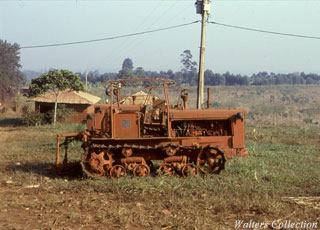
Figure 6. All your tractor are belong to us. Soviet-era Russian tractor stands sentinel near Ngaoundéré, Cameroon, evoking some long-ago combat scene. (Image: Walters Collection)
The Farm Settlement schemes in Anglophone countries mostly failed their objectives; the 1980s Unités Expérimentales research-extension alliance in Sénégal was hit and miss; the Tanganyika Groundnut Scheme, an epic failure; the Gezira-irrigated cotton scheme in Sudan, a marvel of engineering that failed to cash flow its infrastructure (now transitioning to rice?); and the infamous Office du Niger-irrigated rice scheme in Mali. The Office du Niger project is arguably the most enduring of the lot, but its fate since the 2012 insurgency remains unknown. In Africa, everything seems to hang by a gossamer. As Henk Mutsaers opines, for all the foreign aid directed at alleviating food insecurity in Africa over the past half-century, the continent still struggles. Why?
Unfortunately, Mutsaers does not offer a clear answer. Insofar as the FSR-inspired bandwagon was concerned, the author observed that “research stations in Africa were so different from a real farm that it made no sense at all to do detailed studies on crop management under conditions which only remotely resembled those of the farmer”. Moreover, too many field trials were designed “to rediscover things which had been found out countless times before or were in no great need of being found out”, and answering “evermore detailed questions which originated mainly in the scientists’ own minds, assisted by imaginary conversations with some phantom African farmers”. The author laments the devolution of FSR into a ritualized, self-serving professional cult where incantation of mumbo-jumbo like “linkages” and “capacity building” was valued above tangible outcomes that have a rational basis for measuring. In effect, the return to subsistence farmers after decades of research and development has been essentially nil. But not quite nil. Mutsaers points to some bright spots, like the testing and dissemination of Mucuna pruriens for speargrass control in the Bénin Republic by government extension services and the NGO Sasakawa Global 2000 Foundation. Impact studies from the late 1990s estimated that 14,000 farmers had used, or were still using, Mucuna.
Is Mucuna still planted by farmers in the Republic of Bénin today? What happened when extension workers stopped providing Mucuna seeds? What durable impact has Mucuna had on smallholder productivity in the Bénin Republic? We do not find these things out because the success of development projects “cycles” is measured by short-term impacts, which are quite apart from changing how people do things, in perpetuity. Generations of extensionists have relentlessly pitched legumes as cover crops and soil improvers. To paraphrase Henk Mutsaers, one cannot fail to be impressed by the magic of legumes. Legumes, however, are nothing new in agriculture. Nonetheless, each generation seems to rediscover legumes as something equivalent to finding the philosopher’s stone. Each time we’re told it’s a new approach, a new “understanding”. In reality, efforts to convince farmer-peasants in Africa to adopt legumes have not been successful. Legumes are fascinating plants valued for their ability to fix atmospheric nitrogen. But it’s unlikely that legumes, alone, or in combination, will herald a green revolution in African agriculture anytime soon.
Fast-forward: it’s 2014, and we’re still at it, conjuring the right technology ingredients. Lo and behold, a new paradigm is born to us: the Millennium Villages, a gem of the Earth Institute at Columbia University, United Nations Development Programme, and Millennium Promise (né 2006). This project delivers fertilizer and hybrid seed, among other offerings. The Soils, Food, and Healthy Communities project in Malawi aims to improve soil fertility, sustainability, and rural livelihoods with legumes (again!) and native open-pollinated crops. A multicolor Compact Technical Report for post-conflict Sierra Leone published by the Comprehensive Africa Agriculture Development Programme (CAADP) is larded with talk of “value chains” and “capacity building” across crops, livestock, and fisheries. And this announcement from AGRA, an anti-poverty project founded in 2006 with support from the Rockefeller Foundation and Bill and Melinda Gates Foundation: “Millions of smallholder farmers need to adopt promising ISFM (Integrated Soil Fertility Management; see Mutsaers, p. 373) options to generate sustainable yield increases and make farming more profitable.”
Will smallholders adopt ISFM practices this time around? Will these earnest projects succeed in creating a productive, sustainable template for African agriculture that eradicates poverty and food insecurity, as they promised but failed to deliver before? That, of course, is difficult to predict. But the odds aren’t tremendously good. Such projects may have a local impact, but I predict their long-term impression will scarcely register on the scale of development. Nonetheless, African agriculture is destined to change, driven by forces beyond NGOs’ control and operating outside their sphere. Tax and public policy incentives, education, patterns of global investment and trade, land tenure reform, mobile digital communication, GIS and deep learning3 technology, are most likely to stimulate private investment, mechanization, and growth in all sectors, including agriculture. For all the infectious goodwill, trampled warriors, and empty aid coffers, this may just be how poverty ends, worldwide.
In closing, I submit that few people have witnessed, let alone examined, honestly, the troubled legacy of agricultural development in the last half of the 20th century as intimately as Henk Mutsaers (the late Norman Borlaug comes to mind). For this reason alone, Peasants, Farmers and Scientists stands as a landmark achievement. If you have ever hankered for the philanthropic life, or donated money for mosquito nets (rumor has it they make superb fishing nets), I urge you to read this book. If you’re not an agronomist, find one to explain the basics. You’re bound to learn something about food production in the process, which is a good thing. Sadly, the price of admission is a wallet-busting US$150+ per copy (Springer is an academic publisher catering mainly to institutional clients, no remainders). Even your faithful blogger and Acme Scientific Research Collaborative®CEO was reduced to borrowing a copy, fathom that.
Cheer up, though. At least you get to read this blog for free.
End Notes
1 Coincidentally, the author and I worked at ENSA in Cameroon but at different times. I was there in the late 1980s during the construction of the new campus at Dschang, quite a distance from Yaoundé. The Dschang campus was a World Bank-funded project heralded as a new model for agricultural education and development across Africa. In turn, the project engaged leading academic talent from Europe, Asia, and the U.S. I was not in that rank. Nonetheless, it was a prized opportunity to hobnob with (and learn from) some big shots in the field of tropical agriculture.
2 The interspecific upland hybrid sativa X glabberima a.k.a. NERICA rice was finally introduced in 1996 by the Africa Rice Center (né WARDA). NERICA’s creator, Monty Jones, won the 2004 World Food Prize for his efforts.
3 In 2014, when I wrote this piece, the term “deep learning” anticipated what is now called “Artificial Intelligence (AI),” exemplified by the iSDA Virtual Agronomist, developed with funding from the Bill and Melinda Gates Foundation. This tool holds great potential, but it’s unclear whether VA in Africa can walk on its own legs financially.
Disclaimer: I have no relations with the book author or publisher Springer. Links to digital content in this blog are for the reader’s information only, not an endorsement of that content.
Updated by the author 18 April 2019. Link check. Some links remain unresolved.
Second update by the author 27 November 2019.
Third update by the author 25 January 2022.
Fourth update by the author 02 November 2024.
Fifth update by the author 29 July 2026.
Further Diggings
Bingen, R. James and Jacques Faye. 1987. Agricultural Research and Extension in Francophone West Africa: The Senegal Experience. MSU International Development Papers. Reprint No. 13. Available at agricultural-research-and-extension-in-francophone-west-africa.pdf (verified 19 April 2014)
Kang, B. T., G. O. Kolawole, G. Tian, and F. E. Caveness. 1999. Long-term alley cropping with four hedgerow species on an Alfisol in southwestern Nigeria-effect on crop performance, soil chemical properties, and nematode population. Nutrient Cycling in Agroecosystems 54(2): 145–155.
Kleene, P., and H.J.W. Mutsaers. 2012. What is the matter with African agriculture?: Veterans’ visions between past and future. KIT Publishers, Amsterdam. In the same vein as PFS, conversations with those who were (and still are) on the front lines about accomplishments, failures, and what’s needed to meet Africa’s future challenges. Balanced with African, Anglo- and Francophone perspectives.
Salazar, A., L.T. Szott, and C.A. Palm. 1993. Crop-tree interactions in alley cropping systems on alluvial soils of the Upper Amazon Basin. Agroforestry Systems 22(1): 67–82.
Szott, L.T., C.A. Palm, and P.A. Sanchez. 1991. Agroforestry In Acid Soils Of The Humid Tropics. p. 275–301. In Nyle C. Brady (ed.), Advances in Agronomy. Academic Press.
Tian, G., B.T. Kang, and G.O. Kolawole. 2003. Effect of fallow on pruning biomass and nutrient accumulation in alley cropping on Alfisols of tropical Africa. Journal of Plant Nutrition 26(3): 475–486.
Tian, G., B.T. Kang, G.O. Kolawole, P. Idinoba, and F.K. Salako. 2005. Long-term effects of fallow systems and lengths on crop production and soil fertility maintenance in West Africa. Nutrient Cycling in Agroecosystems 71(2): 139–150.
Wallach, B. 1988. Irrigation In Sudan Since Independence. Geographical Review 78(4): 417. Available at irrigation-in-sudan-since-independence.pdf (verified 19 April 2014)