An Imperfect Measure of Purity—Round 2
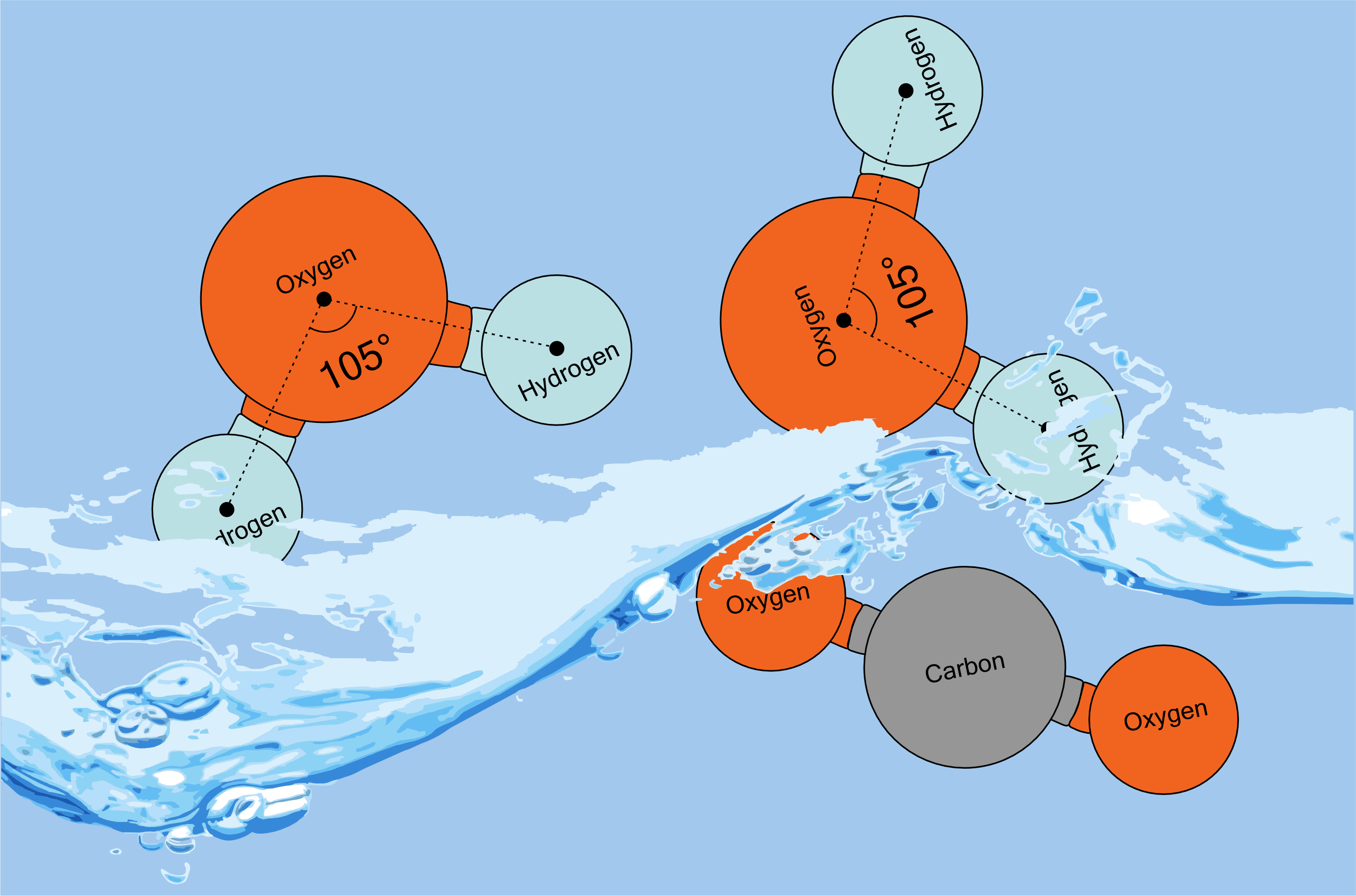
The electrical conductivity of "pure water" is determined by auto-ionization of water molecules and the dissolution of atmospheric CO2 according to Henry's law, coupled with carbonate equilibria. The whole system balances on temperature and pressure.
In Round 1, we scrutinized the textbook claim that pure water is a perfect insulator. This statement is paradoxical and, as we countered, incorrect. By examining water's molecular structure, we established why water exhibits electrical conductivity, a universal material property and fundamental measure of salinity in water quality. In Round 2, we extend these observations to determine the theoretical minimum conductivity of pure water and explain why no definition of "pure water" yields exactly zero conductivity. Tighten your wigs, conquistadores, we're voyaging to the electrochemical headwaters in this round.
The meaning of "pure water" in the context of electrical conductivity has two definitions: a theoretical, idealized definition and a practical definition. The idealized definition, in its strictest sense, refers to water containing only H2O molecules and nothing else:
- no dissolved gases (including CO2, O2, and N2)
- no dissolved ions (salts, acids, or bases)
- no particulate or organic contaminants
This theoretical ideal is nearly impossible to achieve and sustain in the real world.
Then, there's "Ultrapure Water," often called Type I Water, referenced by ISO 3696 and ASTM D1193, with the following specifications:
- Conductivity: 0.055 µS/cm at 25°C
- Resistivity: 18.2 MΩ/cm at 25°C
- pH: 6.998 at 25°C
- Total Organic Carbon (TOC): < 10 ppb (parts per billion)
There's also Type II Deionized Water (DI Water) and Type III Distilled Water, produced by ion exchange resins and distillation, sometimes both, with the following characteristics:
- Conductivity: 0.1-5 µS/cm at 25°C
- Resistivity: 2 MΩ/cm ≤ ρ ≤ 1.0 MΩ/cm at 25°C
- pH: 5.7–7.5 at 25°C
- TOC: Type II ≤50 ppb Type III: not specified
Type II and Type III Waters are typically what's used for routine laboratory work, where purity specifications can be relaxed somewhat. "Pure" rainwater has no specification attached to it but may be considered free from atmospheric gases (CO2, O2, N2) and anthropogenic pollutants, at least the moment it condenses. However, the purity of rainwater degrades nearly instantaneously. Rainwater in equilibrium with atmospheric CO2 (415 parts per million in 2025) has a pH of 5.6 and a conductivity of ~0.99 µS/cm at 25°C, as we shall validate.
Note that, for all classifications of water, conductivity is non-zero. What ions, then, are present to establish conductivity even in Ultrapure Type I Water?
First, pure water is never a "perfect" insulator, even under stringent conditions, because water itself undergoes auto-dissociation (self-ionization):
H2O ⇌ H+ + OH– (or more accurately: 2H2O ⇌ H3O+ + OH–)
At 25°C, the equilibrium constant (Kw) = 1.01 × 10⁻¹⁴ mol/kg-2 H2O (Marshall and Frank, 1981), giving:
Kw = [H+]×[OH–]
Kw = [H+]2 (since [H+] = [OH–])
[H+] = √Kw
[H+] = √1.01 × 10⁻¹⁴
[H+] = 1.0005 × 10⁻⁷ mol/L
[H+] = [OH–] = 1.0005 × 10⁻⁷ mol/L
In pure water, the ionic concentration due to auto-dissociation alone yields a pH of 7.0. We can check this:
pH = -log10[H+]
pH = -log10(1.0005 × 10⁻⁷)
pH = 6.998
This is within the measurement uncertainty, given that numerous experimental values for Kw have been reported.
The H+ and OH– ions mobilize via proton hopping (the Grotthuss mechanism), rather than via diffusion, which is the dominant mechanism for ion transport in solution.
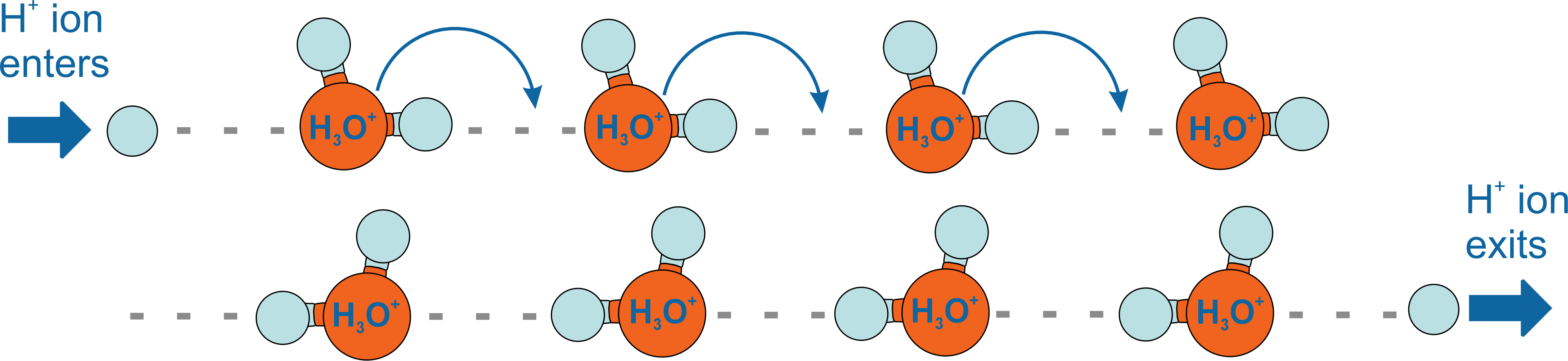
The Grotthuss mechanism describes how protons (H+) move through water not by physically diffusing through the liquid, but by sequential proton transfers along chains of hydrogen-bonded water molecules. Hydroxide ions (OH–) also move via a Grotthuss-like mechanism, but the process differs in important ways and has been more controversial to characterize. Graphic: R. Walters
We must now determine the ionic conductivity per charge (symbol: λ), representing the conductivity contribution of one equivalent of the ions H+ and OH– at infinite dilution. This sounds scary, but fortunately, these values are readily available from published sources like the CRC Handbook (Rumble, 2025):
H+ = 349.8 S/cm²/equivalent
OH– = 198.6 S/cm²/equivalent
Note that the units of ionic conductivity are siemens (S) per square centimeter (cm2) per equivalent. In chemistry, an "equivalent" represents the charge contribution of an ion; for example, H+ has one equivalent (single charge, monovalent), Ca2+ has two equivalents (2+ charge, divalent), and so on. The conductivity of a solution is given by the total specific conductivity equation:

Where:
- κ = conductivity1 (S/cm)
- λ°ᵢ = equivalent conductivity of ion "i" at infinite dilution (S/cm²/equivalent)
- cᵢ = concentration of ion "i" (equivalent/cm³)
- |zᵢ| = absolute value of the charge on ion "i"
- Sum is over all ions
Recall that for pure water, only two ions are present. Hence, the electrical conductivity of pure water is given by:
κ = λ(H+) × [H+] + λ(OH–) × [OH–]
The concentration must now be expressed as the number of equivalents per cubic centimeter (equivalent/cm3). Starting with moles per liter (mol/L), which is the more common expression of ion concentration, we determine that:
1 mol/L = 1 equivalent/L (for monovalent ions)
1 L = 1000 cm³
Therefore: 1 mol/L = 0.001 equivalent/cm³
Using this relationship, we can calculate ci, the concentration of H+ and OH– ions in equivalents per cubic centimeter:
[H+] = 1.0351 × 10⁻⁷ mol/L × 0.001 = 1.0351 × 10⁻¹⁰ equivalent/cm³
[OH–] = 1.0351 × 10⁻⁷ mol/L × 0.001 = 1.0351 × 10⁻¹⁰ equivalent/cm³
Lastly, we find the sum of the products (λᵢ × cᵢ) in the conductivity equation:
From H+:
κ(H+) = 349.8 S/cm²/equivalent × 1.0351 × 10⁻¹⁰ equivalent/cm³
κ(H+) = 3.6207 × 10⁻⁸ S/cm
And from OH–:
κ(OH–) = 198.6 S·cm²/equivalent × 1.0351 × 10⁻¹⁰ equivalent/cm³
κ(OH–) = 2.0557 × 10⁻⁸ S/cm
Total conductivity is the sum of the individual conductivities:
κ = κ(H+) + κ(OH–)
κ = 3.6207 × 10⁻⁸ + 2.0557 × 10⁻⁸
κ = 5.6764 × 10⁻⁸ S/cm
This yields the total conductivity in S/cm, whereas the specification for Type I "Ultrapure" Water is given in µS/cm. Since 1 S = 106 µS:
κ = 5.6764 × 10⁻⁸ S/cm × 106
κ = 0.0568 µS/cm
Conductivity of Type I Ultrapure Water = 0.057 µS/cm at 25°C (rounded to three significant digits).
The difference (< 3%) is within the expected uncertainty for the ISO 3696 and ASTM D1193 specifications, 0.055 µS/cm. However, the conductivity of Type I Ultrapure Water is certainly not zero!
Type I Ultrapure Water also has a measurable resistivity (ρ), defined as the reciprocal of conductivity2:

ρ = 1 / (5.6764 × 10⁻⁸ S/cm)
ρ = 1.7617 × 10⁷ Ω/cm
Since the specification for Type I Water is given in Megaohms per centimeter (MΩ/cm), the following conversion applies:
ρ = 1.7617 × 10⁷ Ω/cm / 106
ρ = 17.62 MΩ/cm
Resistivity of Type I Ultrapure Water = 17.62 MΩ/cm at 25°C.
Again, the difference is within the expected uncertainty for the ISO 3696 and ASTM D1193 specifications, 18.24 MΩ/cm.
Next, let's examine what happens when Type I Ultrapure Water is exposed to atmospheric CO2. This will lean on Henry's law, which quantifies the solubility of gas under pressure:

Where:
- C = concentration of dissolved gas in a liquid (mol/L)
- KH is Henry's law constant of proportionality (Henry's law constant)
- Pgas is the partial pressure of the gas (usually in atm)
When CO2 first dissolves in water, it forms carbonic acid:
CO2(aq) + H2O ⇌ H2CO3 ⇌ H+ + HCO3–
This is a multi-stage dissolution equilibrium, where CO2(aq) represents the dissolved carbon dioxide gas in water, i.e., molecules that have crossed the air-water interface but have not yet reacted chemically with water; H2CO3 is the undissociated carbonic acid, which dissociates to release a proton (H+) and bicarbonate ion HCO3–.
The complete system spans four carbon-containing species:
CO2(aq) ⇌ H2CO3 ⇌ HCO3– + H+ ⇌ CO32– + 2H+
The relative abundance of each depends strongly on pH.
For Henry's law calculations, we need the atmospheric concentration of CO2 and its partial pressure. As of 2025, atmospheric CO2 levels were reported at 415 ppm (parts per million). The partial pressure of CO2 is given by:
pCO2 = (415 ppm / 1,000,000) × 1 atm = 4.15×10⁻⁴ atm
This is the partial pressure of CO2 in the atmosphere at sea level.
For CO2 at 25°C, KH ≈ 0.034 mol/(L/atm) (Plummer and Busenberg, 1982 and others).
This means that at 1 atm of pure CO2, 0.034 moles of CO2 per liter of water would dissolve.
Using Henry's Law at 25°C:
[CO2(aq)] = KH × pCO2
[CO2(aq)] = 0.034 mol/(L/atm) × 4.15×10⁻⁴ atm = 1.41×10⁻⁵ mol/L
This is the total dissolved CO2 that would be in equilibrium with atmospheric CO2.
However, we want to calculate the conductivity of pure water in equilibrium with 415 ppm atmospheric CO2. For this, we need the equilibrium concentration of all ion species present in water when the dissolved CO2 concentration is 1.41×10⁻⁵ mol/L, per Henry's law. These would include H+, HCO3–, OH–, CO32-. We can then utilize the conductivity equation to calculate κ.
This is a multi-step procedure that employs a set of constants; exact values may vary by source. We employ the Plummer and Busenberg (1982) ones below.
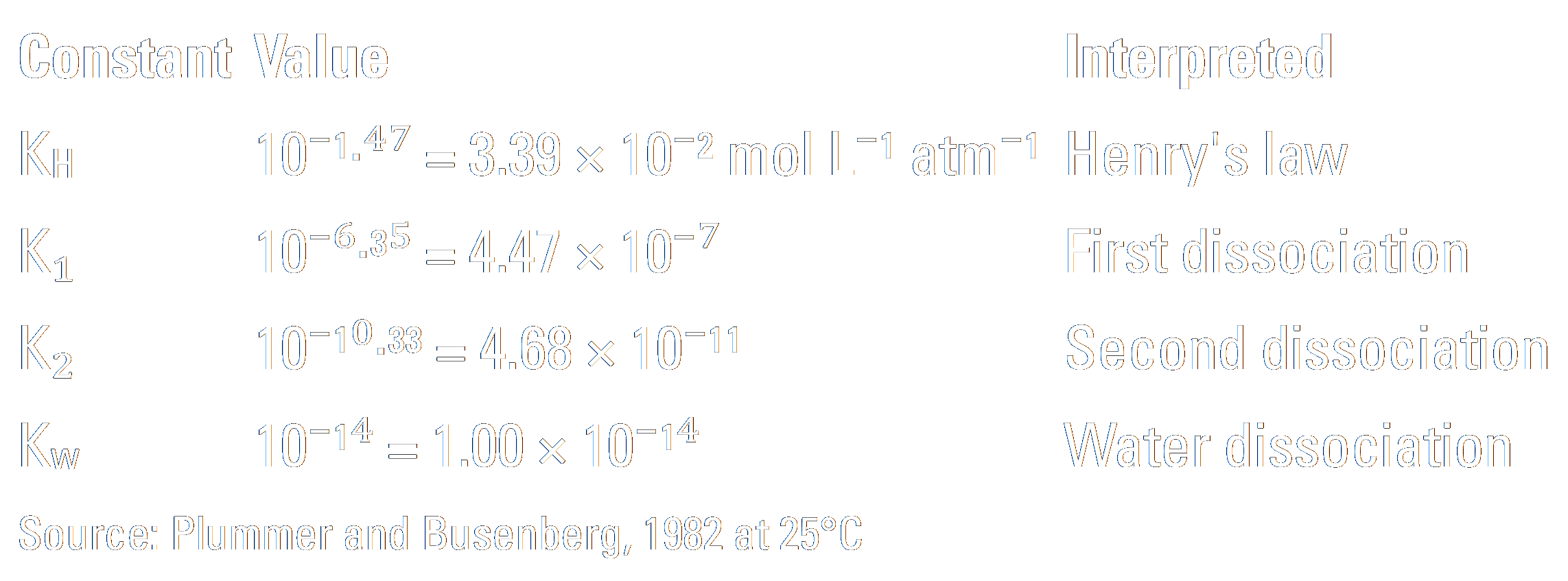
Step 1: Solve for the concentration of H+, HCO3–, OH–, and CO32– ions.
For [H+], the hydrogen ion concentration for the charge balance in pure water with dissolved CO2, we observe that:
[H+] = [HCO3–] + 2[CO32–] + [OH–]
At pH < 8, [CO32–] and [OH–] are negligible, so:
[H+] ≈ [HCO3–]
Since the given dissociation constant Kw of pure water under auto-ionization is 1.00 × 10⁻¹⁴ its pH is:
pH = −log10(1.00 × 10⁻¹⁴)
pH = 7.0
So, it's justified to set [H+] = [HCO3–] in this system.
From the first dissociation equilibrium:
K1 = [H+][HCO3–] / [CO2(aq)]
Substituting [H+] = [HCO3–]:
K1 = [H+]² / [CO2(aq)]
[H+]² = K1 × [CO2(aq)]
[H+]² = (4.47 × 10-7) × (1.407 × 10-5)
[H+]² = 6.29 × 10⁻¹²
Solving for [H+] = √6.29 × 10⁻¹²
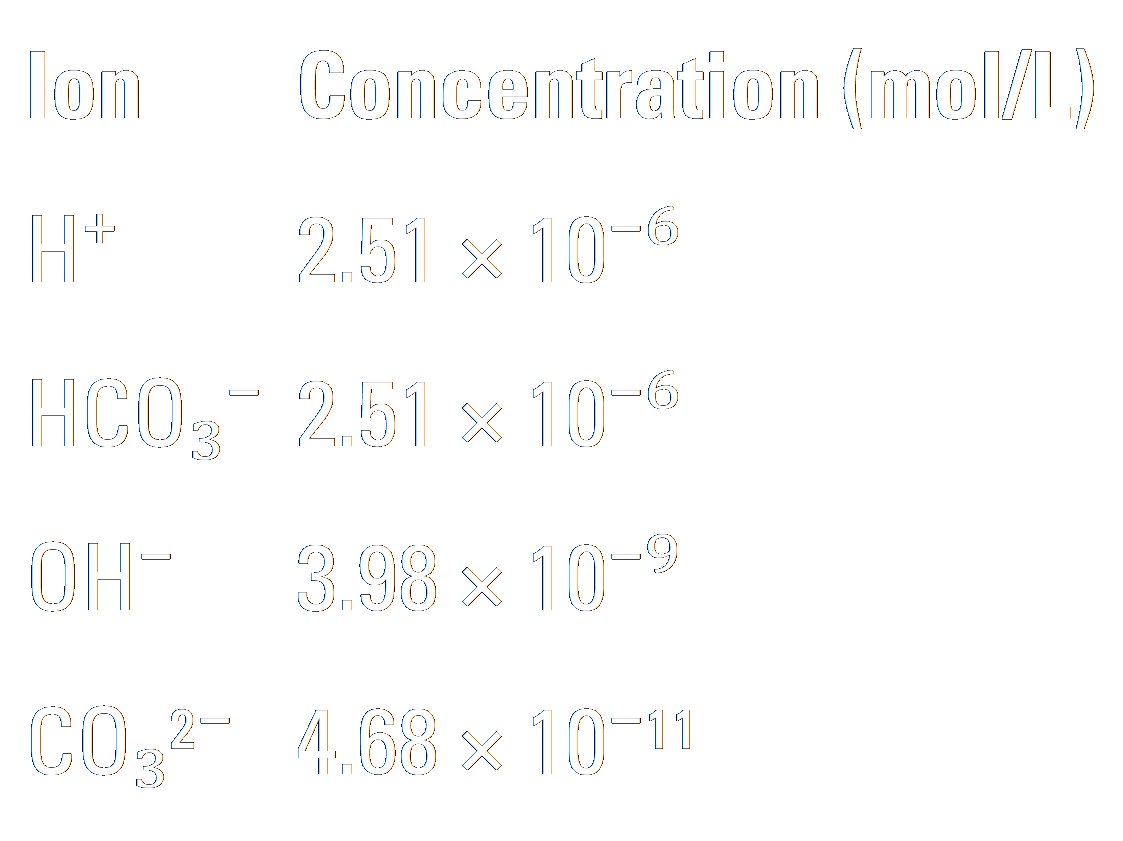
[H+] = 2.51 × 10⁻⁶ mol L-1
The pH of pure water in contact with atmospheric CO2 is:
pH = −log10(2.51 × 10⁻⁶)
pH = 5.60
This is classified as mildly acidic. Water with a pH below or above this level must contain other acids or bases and would be considered impure.
The OH– concentration follows directly from:
Kw = [H+] [OH–] = 1.00 × 10⁻¹⁴ at 25°C

The answer 3.98 × 10⁻⁹ mol/L is reasonable because the H+ concentration is elevated above the neutral pH (10-7 M) due to the formation of carbonic acid from dissolved CO2, which dissociates to release H+ (protons). Since the water equilibrium constant Kw remains fixed at 25°C, as [H+] increases, [OH–] must decrease proportionally.
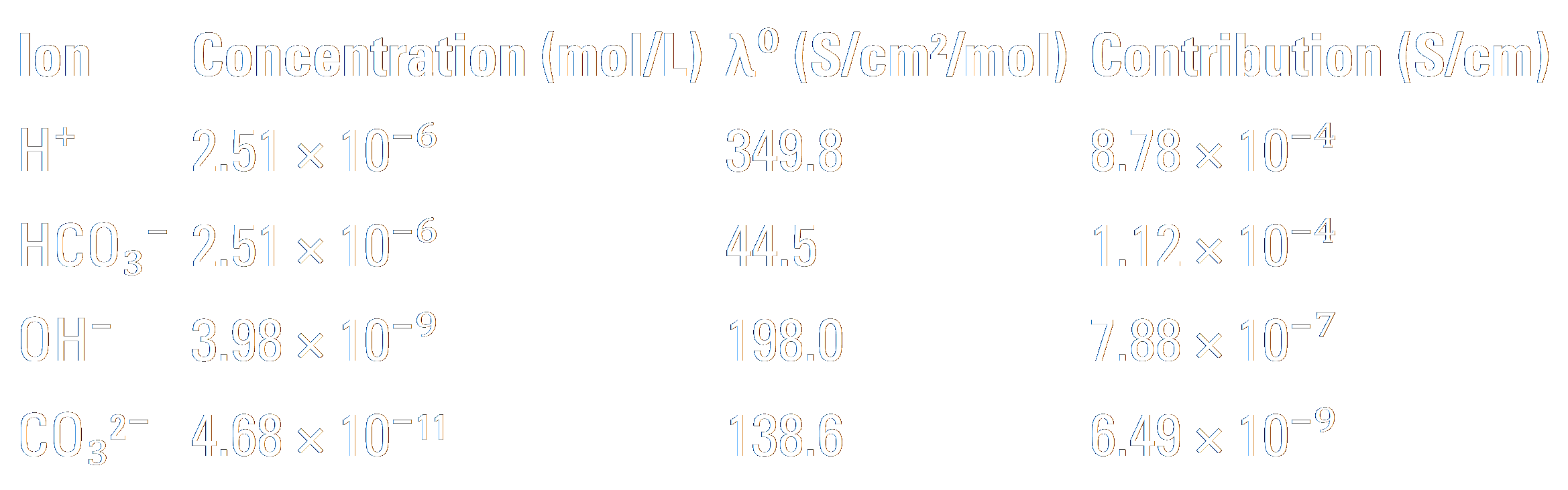
The concentration of ions in pure water in equilibrium with CO2 is summarized by:
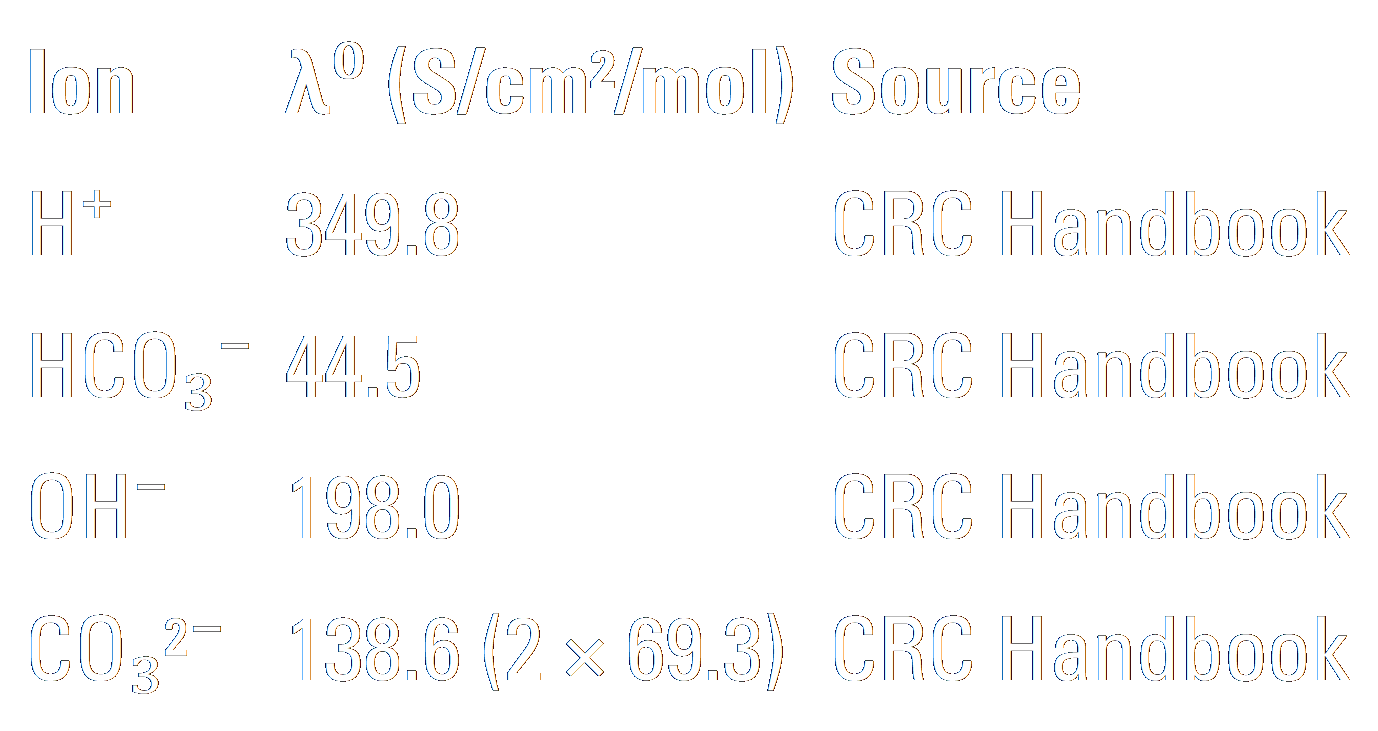
Step 2: Solve for the molar ionic conductivity of H+, HCO3–, OH–, and CO32–. For brevity, we use published values at infinite dilution (λ°, 25°C):
Step 3: Solve for total EC using the conductivity equation:
EC = Σ (ci × λi°)
Summary of the individual contribution of ions to conductivity, tabulated:
At this point, all that remains is to sum up the individual contributions to obtain the total specific conductivity:
κ = 8.78 × 10⁻⁴ + 1.12 × 10⁻⁴ + 7.88 × 10⁻⁷ + 6.49 × 10⁻⁹
κ = 9.91 × 10⁻⁴ S/cm
Then convert to µS/cm:
κ = 9.91 × 10⁻⁴ S/cm × 106 µS/S
κ = 0.99 µS/cm
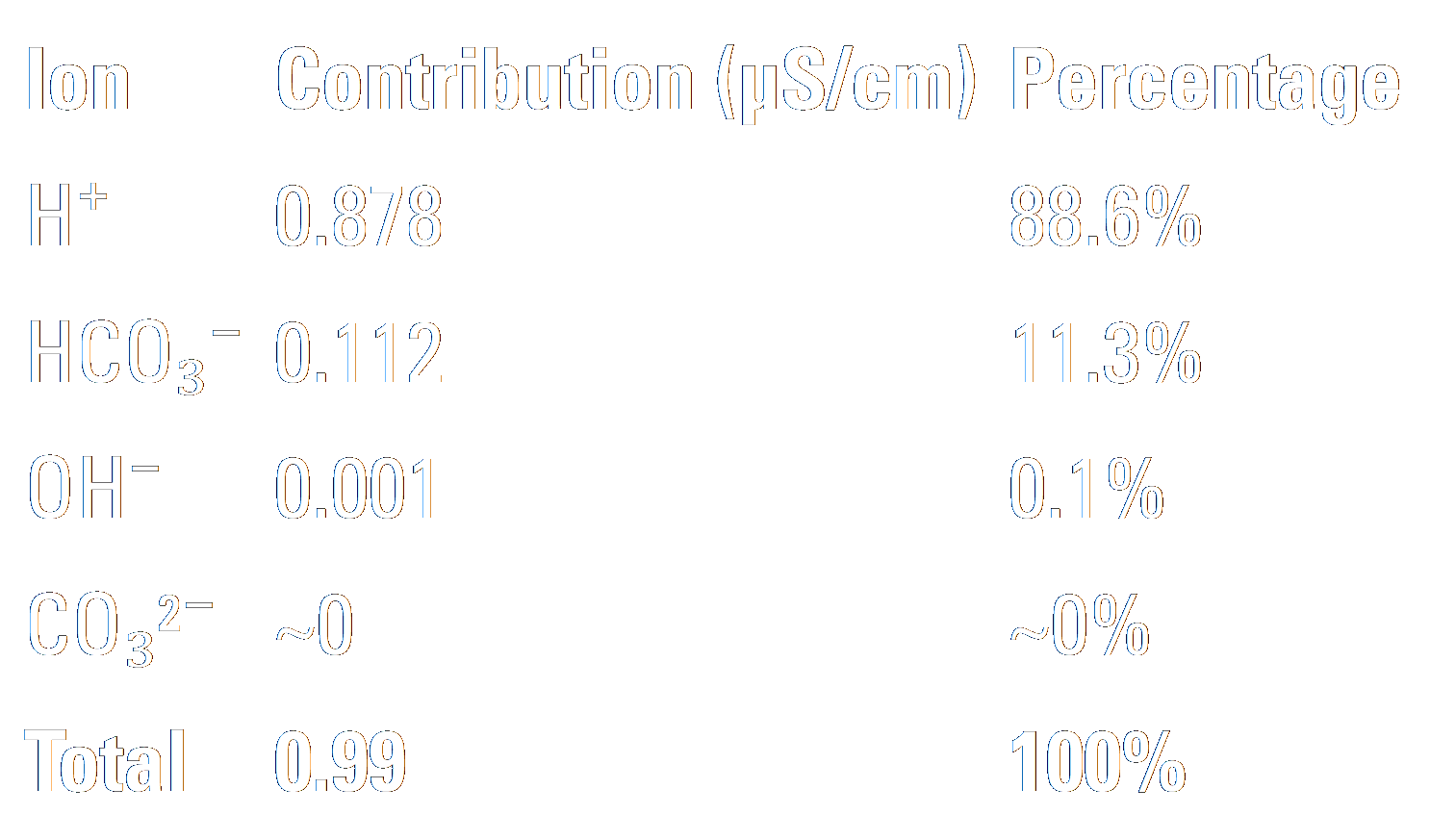
The fractional contribution breakdown is:
Summary of pure water chemistry in a closed and open system at 25°C:
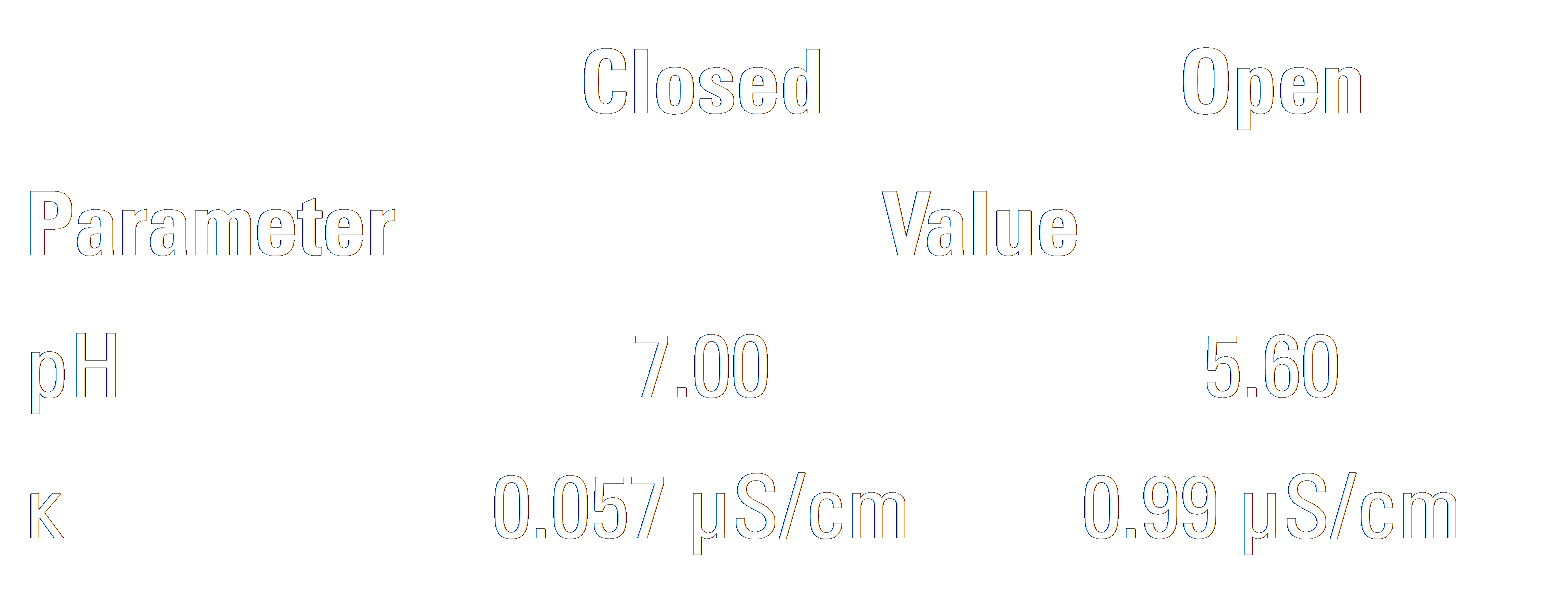
This shows, definitively, that exposure to atmospheric CO2 (415 ppm) in an open system increases the conductivity of pure water by ~17.4×. In effect, rising CO2 levels are salting and acidifying the Earth:
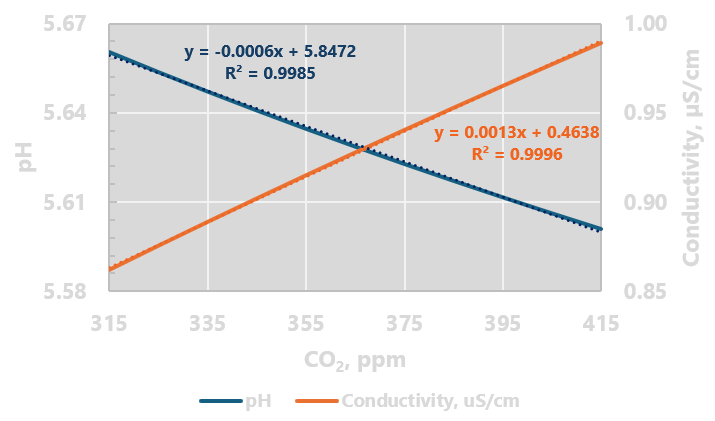
Relationship between pH and EC of pure water in equilibrium with varying atmospheric CO2 concentrations. The first scientifically rigorous, monthly average measurement of atmospheric CO2 was 315 ppm, conducted by Charles Keeling in 1958 at Mauna Loa Observatory in Hawaii.
All the calculations we have done so far have been at a fixed temperature of 25°C and a pressure of 1 atm (sea level) to keep things simple. However, temperature and pressure are not constant across the Earth. The solubility of CO2 gas in water is modulated by temperature and pressure according to Henry's law:
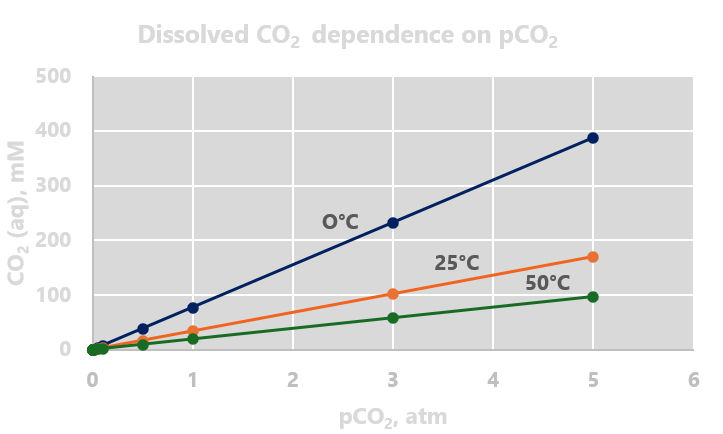
Henry's law predicts significantly more dissolved CO2 at 0°C than at 50°C for a given partial pressure. This is because gas solubility in liquids is an exothermic process: as you add thermal energy (heat), you give the dissolved gas molecules enough kinetic energy to overcome the attractive forces of the water molecules and escape back into the atmosphere.
Which, in turn, influence pH and κ (EC), but in vastly different ways:
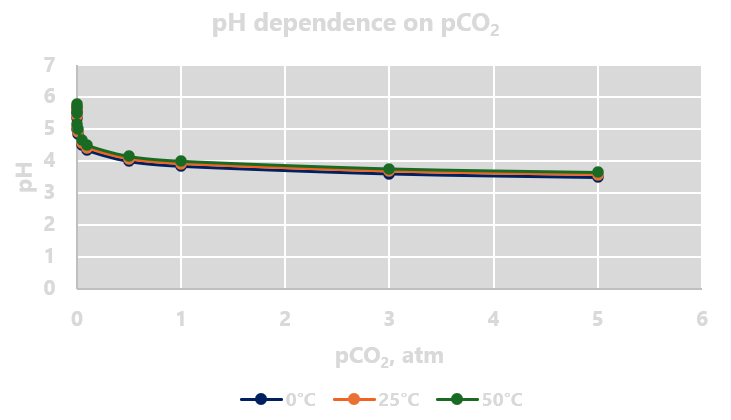
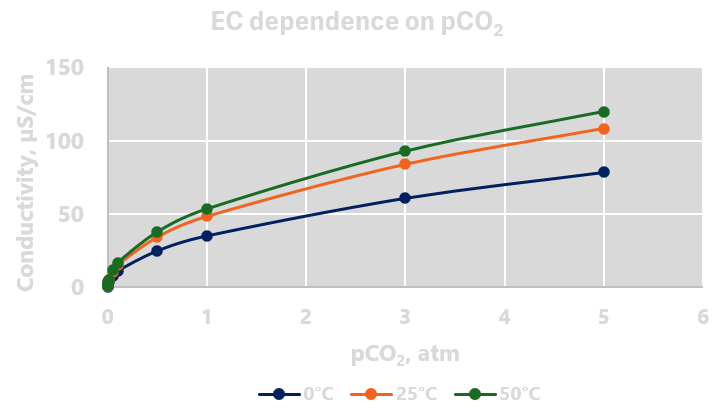
This may portray an overly complex picture of EC for those uninitiated in the chemistry brotherhood, but the key point is this: The universality of EC stems from the fundamental physics wherein all materials contain charged particles (electrons, ions), and under an applied electric field, there's always some mechanism, however inefficient, for charge transport. Whether it's free electrons in metals, electron-hole pairs in semiconductors, self-ionizing proton hopping (Grotthuss mechanism), or ionic diffusion in electrolytes and even solids, conductivity is never truly zero.
Theoretically, for the electrical conductivity of water to be exactly zero, the "perfect insulator", you would need to achieve a state of absolute hermetic purity and absolute inhibition of auto-ionization at absolute zero (-273.15°C) temperature. At this temperature, molecular motion stops, and the energy required for auto-ionization is no longer available. Such conditions are virtually impossible to meet in a physical laboratory.
In short, water is a "universal solvent" that effectively generates its own conductors. You can get close to zero, but the laws of thermodynamics and the nature of the H2O molecule itself ensure there is always a tiny "hum" of electricity possible.
Footnotes
1 In chemistry and electrochemistry, the lowercase Greek letter kappa (κ) symbolizes the conductivity of aqueous (water-based) systems. In physics and electrical engineering, the symbol σ (sigma) denotes electrical conductivity. In practice, scientists in either field often bypass Greek notation and use the acronym "EC" for electrical conductivity. Herein, we utilize kappa and EC interchangeably, formally and informally, as the case dictates.
2 Any material with measurable conductivity also has reciprocal resistivity, including the soil on which crops are grown and buildings are stabilized. Measuring soil resistivity is critical for grounding electrical infrastructure and for corrosion assessment (pipelines, tanks, foundations, and rebar steel). Measurement methods for soil resistivity differ from those for salinity conductivity.
Further Diggings
Rumble, J.R., Ed. CRC Handbook of Chemistry and Physics, 106th ed.; CRC Press: Boca Raton, FL, 2025. ISBN 978-1032655666.
Marshall, W.L. and Franck, E.U. (1981). Ion product of water substance, 0-1000°C, 1-10,000 bars. New international formulation and its background. J. Phys. Chem. Ref. Data, 10(2), 295-304. DOI: 10.1063/1.555643
Plummer, L.N. and Busenberg, E. (1982). The solubilities of calcite, aragonite, and vaterite in CO2-H2O solutions between 0 and 90°C, and an evaluation of the aqueous model for the system CaCO3-CO2-H2O. Geochimica et Cosmochimica Acta, 46(6), 1011-1040. DOI: 10.1016/0016-7037(82)90056-4
Seinfeld, J.H. and Pandis, S.N. (2006). Atmospheric Chemistry and Physics: From Air Pollution to Climate Change, 2nd ed. John Wiley & Sons, Hoboken, NJ.
Stumm, W. and Morgan, J.J. (1996). Aquatic Chemistry: Chemical Equilibria and Rates in Natural Waters, 3rd ed. John Wiley & Sons, New York.
Disclaimer: Links to digital content in this blog are for the reader's information only, not an endorsement of that content.