Climate “Smart” or Climate Semantics?
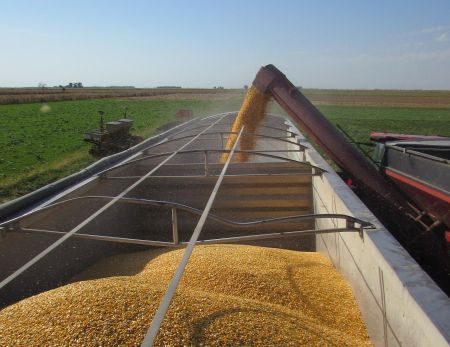
Unloading combined corn grain during harvest. Farmers have rationalized fossil fuel-powered, climate-adverse inputs, including synthetic fertilizers based on measured productivity and returns. What are the parallel benefits of climate "smart" agriculture, and how do we measure them?
There’s a new kid on the block tugging at the global development purse strings. It’s called climate “smart” agriculture, heir apparent to sustainable agriculture, the latter aging passé with trend-conscious consultants who design projects for international donors like USAID, The World Bank, United Nations entities, and their contractors. Even global centers like the Consultative Group on International Agricultural Research (CGIAR) have been smitten. I have heard the term “climate-smart” used indistinctly in different settings over the past year or so, but I did not pay it much attention. My bad. Now, it seems, the climate-smart paradigm is in heavy rotation by purveyors of international development. But what exactly is climate “smart” agriculture (CSA)? What does CSA really mean to a smallholder remotely located in, say, Burkina Faso or Bangladesh? Or to operators here at home in North Carolina? Is CSA a path forward for global agriculture, or is it just another semantic pivot toward re-stocking R & D coffers?
Don’t get me wrong: I love a good paradigm shift as much as anyone. I have also witnessed my share of development folly parading as building capacity for food security, when in fact the smallholder’s situation has not perceptibly changed after the project money runs out. Of course, this is not always the fault of aid agencies and practitioners. From my experience, reshaping agriculture is difficult no matter where you operate. Which is, in my opinion, a good thing. Farmers understand the peculiar risks and vagaries of their operations better than distant spectators; indeed, why should the agricultural sector pay attention to outsiders who say it needs to become climate-smart to succeed?
Yet, the climate-smart bandwagon continues to roll out. The question is whether CSA represents a break from past initiatives or, more pertinently, a new model for global agriculture?
The term “climate-smart agriculture” dates back to 2010, when the United Nations Food and Agriculture Organization (FAO) first defined and presented the concept at the Hague Conference on Food Security, Agriculture, and Climate Change. Here, CSA was defined as “agriculture that sustainably increases productivity, resilience (adaptation), reduces/removes GHGs (mitigation), and enhances achievement of national food security and development goals”. The acronym ‘GHG’ stands for greenhouse gases, atmospheric gases that absorb and/or emit infrared (IR) radiation, i.e., radiant heat, thereby contributing to the greenhouse effect (global warming). The main GHGs generated by agriculture are carbon dioxide (CO2), methane (CH4), and nitrous oxide (N2O). CSA was seen as an attempt to reset the global development agenda, uniting the priorities of the agriculture sector with those of the climate change community. As such, CSA attempts to direct focus on sustainability, climate mitigation, and resilience, collectively the ’triple win’, implying that farmers should adopt CSA techniques for their own good and that of the planet.
There is no question that climate influences agriculture. Farmers are keenly aware of patterns of air temperature, rainfall, solar radiation, wind direction and velocity, and humidity in their locale and have devised many clever adaptations to compensate for less-than-optimal conditions. For example, Chinampas, “floating gardens” in Mesoamerica, have built up soil on shallow lake beds, taking advantage of capillary moisture and the tempering influence of water bodies. Viticulturists exploit their terroir, a biophysical domain that differentiates not only vintage wines but also, presently, lends an artisanal sheen to products like grains and vegetables. High tunnels have enabled the season extension of vegetables and fruits in cool-temperate, frost-prone areas. Upland rice farmers in West Africa mitigate the risk of hit-and-miss early-season rains by planting short-duration rice varieties in the moisture-retentive, nutrient-enriched soils of riverine terraces and slope bottoms.
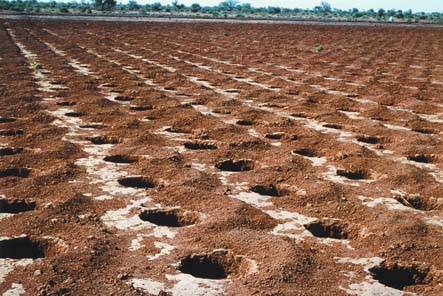
Zaï pits in Niger, West Africa. The pits concentrate scarce water and nutrients, so providing plants a foothold in exhausted, barren lands. The pits are excavated manually, incurring high labor costs. Photo source: FAO.
And Zaï pits have been championed for their ability to restore degraded land in semi-arid sub-Saharan Africa. I don’t know if these efforts qualify as climate-smart agriculture, but all have emerged as spontaneous farmer-led innovations perceived to harness and/or mitigate natural, fairly predictable events, including local weather vagaries, to secure productivity, spread risk, and improve food security.
What, then, does the FAO mean by “agricultural practices that sustainably increase productivity, resilience, and mitigate GHGs”? Do practices have to meet all three criteria simultaneously to be considered climate-smart? Is CSA primarily aimed at smallholders in developing nations or the global agricultural sector? Are GHG-producing fertilizers privileged or verboten? What about GMOs? Fossil fuels? Or should we all anticipate pedal-operated plows? On these points and others, the FAO is notoriously vague. For a deeper analysis, I turned to two recent works: Climate Change and Agriculture Worldwide, a 2016 CIRAD publication, and Earthscan Food and Agriculture’s 2016 Climate Change and Agricultural Development: Improving Resilience Through Climate Smart Agriculture, Agroecology, and Conservation. What have these publications revealed?
Not surprisingly, the CSA concept is directed at resource-limited smallholders in food-insecure nations. Here, smallholders are defined as farm operators with fewer than 2 hectares (5 acres) of land, who are predominant in tropical zones. Beyond that, there is little agreement on what CSA measures, reports, and verifies. Mitigation primarily concerns production techniques to reduce GHG emissions to the atmosphere. Techniques favoring climate mitigation include, coincidentally or not, an array of options known for decades as sound agronomics or “sustainable” and ‘regenerative’ agriculture: soil and water conservation; efforts to increase the level of organic matter in soil; temporal and spatial crop associations; multipurpose trees; local biodiversity and crop genetics; and mixed farming practices. Agriculture that is adapted to climate change is said to be “resilient”, meaning it allows production to continue even in the face of unexpected “disruptions”, whatever that may mean. Curiously, there is nothing in the definition of CSA that would require turning away from large-scale, denaturalizing industrial agriculture. In fact, CSA could, potentially, be any adaptive process, no matter how trivial or accidental. On the other hand, the CSA movement is riven by dissenting ideological and political agendas. Should agricultural inputs be regulated? Who decides which inputs and outcomes are climate-smart, and which are not?
Take fertilizer application, exhibit “A” in the hearts-and-minds struggle. Intensive agriculture in the industrialized nations has rationalized fertilizer use based on measured productivity and return to land and labor. High fertilizer rates affect GHG emissions and pollution. However, fertilizer application by smallholders, particularly in sub-Saharan Africa, is still very low, averaging 10 kg/ha, much less than the 50 kg/ha target set by the 2006 Abuja Declaration, and the global average of more than 130 kg/ha (AGRA, 2014; Roser and Richie, 2017; Vanlauwe and Giller, 2006). Reducing fertilizer in these situations does not make much sense. Extensionists conducting simple, farmer-managed field trials that demonstrate the correct method for applying fertilizer would go a long way toward improving fertilizer efficiency, rather than substituting for or reducing fertilizer use.
Perhaps the biggest push within CSA is for carbon sequestration. Increasing atmospheric carbon dioxide (CO2) concentrations have been linked to fossil fuel burning, land clearing and drainage, soil tillage, and other human activities. Since CO2 accounts for about 75% of the greenhouse gases implicated in climate change (agriculture’s share is 11-15%1), it makes sense to explore ways to remove it from the atmosphere, a process called ‘sequestration’. Where do we put CO2 to achieve sequestration? To answer this, let’s look at the global carbon cycle schematically:
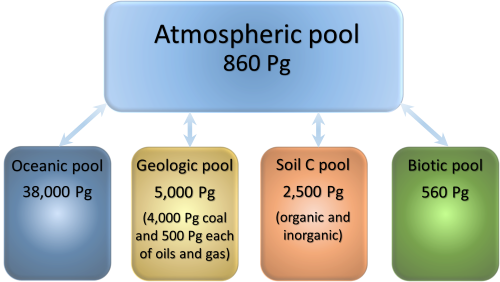
Global carbon pools and their relationships. Redrawn and slightly modified from Lal, 2004.
Here, Earth’s carbon stocks are divided into five major pools: atmospheric, oceanic, geologic, soil, and biotic. The mass of each pool is given in petagrams (Pg), where 1 Pg equals 1 billion (109) metric tons. A metric ton is 1 million (106) grams (=1,000 kilograms) or 2,205 pounds (1.1 US tons). The terms carbon, CO2, and CO2 equivalent (CO2e) are frequently used when discussing greenhouse gases and their impact on global climate change. Understanding the definitions of these terms and their usage is crucial to avoid ambiguity and to avoid getting tripped up. For guidance, the reader is encouraged to check out this concise tutorial.
Another way to express substances like carbon (chemical symbol: C) or gaseous CO2 is concentration, the relative abundance of a substance (elemental C or CO2), in the total amount of a mixture, usually expressed in parts per unit mass or volume (percent: parts per hundred; ppm: parts per million). The mean monthly concentration of CO2 in the atmosphere, measured in December 2016 at the NOAA Earth Systems Mauna Loa observatory, was 404 parts per million by volume (ppmv). Assuming each part per million by volume CO2 equals 2.134 petagrams, the atmospheric carbon pool is 2.134 x 404 = ~860 Pg. Note that all carbon figures in the schematic above are estimates. Estimates are educated guesses subject to error, the magnitude of which is unknown, or in any case not reported by the original author. Carbon pools, however, are constantly changing because CO2 moves in and out of the atmosphere through processes such as photosynthesis, respiration, decomposition, and decay of once-living biomass, and the combustion of organic substances. Thus, it would be incorrect to state that the atmospheric carbon pool is exactly 860 Pg. Nonetheless, the schematic makes three important points: (1) carbon is constantly circulated between global pools (two-headed arrows indicating such movement is possible); (2) the oceanic pool, the largest, contains about 12 times as much carbon as the terrestrial biosphere, i.e. plants and the underlying soil; and (3) the soil contains 4+ times more carbon than the biotic pool (plants and animals).
So, harking back to the question “Where do we put CO2 to achieve sequestration?”, there are essentially two practical options: plants and the soil.
Plants remove CO2 from the atmosphere during photosynthesis. Photosynthesis comprises two separate reactions, first involving energy capture from sunlight (the ’light’ reaction), and secondly, the fixation of atmospheric CO2 in carbohydrates (the ‘dark’ reaction). The potential for carbon sequestration in plants depends on multiple factors that affect the rate of carbon fixation in photosynthesis: air temperature, solar radiation, plant water and nutrient supply, biotic and abiotic stress, among others (see the 2016 Whither Bioenergy? blog for a deeper interrogation of carbon assimilation in photosynthesis).
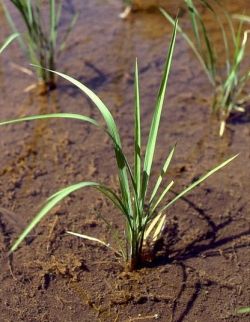
Rice is a "C-3" grass plant sensitive to high-temperature stress, even though widely cultivated in the humid tropics. Rising global temperatures are predicted to boost carbon assimilation and net primary productivity in C-3 plants, but not in C-4 plants. However, this may not always translate to higher grain yield.
Sunlight-to-biomass efficiency for most of the world’s cultivated crop plants is 0.5-2%. The efficiency of carbon fixation has not changed with the breeding and agronomic progress that has so improved crop yield, for example, the Green Revolution. We have simply found ways to “trick” plants into partitioning more of their biomass into useful products like seed grain and oil. Saying that, the effect of rising global temperature should stimulate plant growth up to a point, especially in higher latitudes. Plant growth stages, a.k.a. phenology, are triggered by the accumulation of temperature units during the growth cycle. Rising temperatures may reduce yield by accelerating plant growth, thereby shortening the number of days required to intercept photosynthetically active radiation (PAR). This is particularly important for so-called “C-3” plants (wheat, rice, cotton, groundnut, soybean, etc.) whose mechanism for carbon assimilation is adapted to humid areas without excessive temperature, contrary to “C-4” plants (maize, sorghum, millet, sugarcane) which have evolved more efficient mechanisms for carbon assimilation in high temperature, alternating wet-dry season tropical zones. Where does this position fit in climate-smart agriculture?
Arguably, the most efficient way to achieve long-term carbon sequestration in the biotic pool is to convert agricultural land to forestry and/or agroforestry. Options for land conversion are, however, quite limited, and it is unlikely that even marginal land would be taken out of production if humans depend on it for sustenance. Still, there is potential for preserving existing forests while building soil organic matter through cropping intensification. But higher plant populations also require more inputs, and there is strong evidence that grain yield in biodiverse, intercropped systems may be limited by competitive effects, especially where water and nutrients are scarce. Under these circumstances, intercropping is predicted to flatten rather than increase grain supply (see Muraoka et al., 2016; Tittonell and Giller, 2013). Improvements in food security from intensive intercropping systems under average management are therefore questionable. It would be nice if there were a free lunch back in there somewhere, but alas, there is not.
The picture becomes even murkier regarding regions like West Africa, where rainfall is crucial for agricultural production, and where there is no agreement among the many models predicting either increased or decreased rainfall. Furthermore, satellite data on vegetation from 1981-2007 have shown a greening trend in most arid and semi-arid areas (Fensholt et al. 2012). Should we gear CSA towards hotter and drier terrestrial environments, and if so, where? What about saltwater intrusion with rising sea levels? Toxic levels of salt and boron accumulation in the subsoil? Nutrient exhaustion? Pest monitoring, suppression, and avoidance? Soil compaction from heavy farm machinery? Nitrate leaching into groundwater and its escape into open waterways? Climate-smart agriculture provides no guidance here because it is non-prescriptive; it does not seek to address any particular problem, except “climate change” in a broad sense. CSA simply reiterates practices that have long been deployed as sound agronomic principles and, lately, repackaged under the shibboleth of sustainability, emphasizing climate mitigation. In my view, the optimal model for global agriculture, regardless of what climate change brings, is developing stable, stress-tolerant germplasm capable of exploiting local environments (Reynolds et al., 2016), improved soil management, post-harvest technology, and infrastructure for delivering seed, pest control, irrigation, fertilizer, and timely information to farmers. But that is an old tune!
Another option for carbon sequestration is in the soil. The principal operating mechanism is the transfer of atmospheric CO2 to plants via photosynthesis. In this case, atmospheric CO2 fixed in plant biomass is stored in the soil as organic matter. Conservation agriculture is a climate-smart surrogate for soil carbon sequestration, according to proponents, ensuring favorable outcomes for climate change mitigation. All very well. But what is conservation agriculture?
According to the FAO, conservation agriculture (CA) is a technique that complies with three “plot-level” principles: (1) minimum tillage; (2) crop associations; and (3) permanent cover of soil via plant residue. In the United States, conservation tillage, defined by the Federal National Resources Conservation Service (NRCS) for conservation planning purposes, includes practices that leave at least 30% of the soil surface covered with plant residue (crops or weeds). NRCS does not dictate crop associations, rotations, or permanent soil cover. This implies a fundamental difference between the FAO’s conservation “agriculture” and the NRCS conservation “tillage”: the former is more rules-heavy and provides less operational space for farmers.
There is no denying that shifting away from conventional plow tillage offers multiple long-term benefits for soil and the environment (Lal, 2004). The relevant climate “smart” questions are: How much carbon is sequestered in the soil under conservation tillage compared with conventional plow tillage? Is carbon sequestration in the soil predictable? Are carbon sequestration rates high enough to offset global CO2 emissions from fossil fuels in a manner that would put the brake on climate change? In the follow-on piece, “Carbon Sequestration and Its Discontents”, we’ll take a quantitative stab at these questions by examining global soil carbon data from numerous, well-characterized research plots, as well as carbon reports from North Carolina State University’s long-term agronomy plots at Reidsville.
In the meantime, entertain this heretic’s view:
Climate-smart agriculture, as currently configured by the FAO, CGIAR, and other international centers, is not a path to meeting global food demand, nor is it likely to mitigate climate change in a quantifiable manner. It offers no new approaches or technology options beyond the familiar bundle deployed for decades as sound agronomics. The international donors’ rollout of CSA has been uncoordinated and largely ineffective (Zureck et al., 2014). In turn, the adoption of climate-smart agriculture by smallholders has been very low, and it is unclear what incentives would stimulate future interest. The permanent adoption of climate-friendly conservation agriculture practices by smallholders in sub-Saharan Africa has also lagged. There are valid agronomic, economic, and social reasons why smallholders do not implement CSA and CA (see Vanlauwe and Giller 2006; Giller et al., 2009). In most cases, conservation practices have been adopted selectively, but certainly not for climate change mitigation. Further, it is unclear what, if anything, CSA measures, reports, and validates about climate change. CSA is non-prescriptive, as it does not remove biophysical or infrastructure constraints that would foster higher productivity and, in turn, build food security worldwide.
Such are my initial unflattering impressions of CSA. Of course, there may be brilliant success stories I am not aware of, leaving open the possibility that my opinion of CSA could change on further analysis. But I’m not holding my breath. Feeding a human population surpassing 10 billion while incurring the fewest possible environmental regrets is one of humanity’s grand challenges. It will require more effort than playing semantic games.
Footnotes
1 Global agricultural GHG emission estimates vary widely, with 11-15% frequently cited. There is a methodology for predicting GHG emissions from certain agricultural practices but farm-level measurements are rare.
Further Diggings
AGRA, 2014. Seeking fertile ground for a green revolution in Africa. Nairobi: Alliance for a Green Revolution in Africa (AGRA). Available at https://allafrica.com/download/resource/main/main/idatcs/00090180:cba13aa115b324f0619201994da6e9f4.pdf
Fensholt, R., Langanke, T., Rasmussen, K., Reenberg, A., Prince, S., Tucker, C., Scholes, R. et al. 2012. Greenness in semi-arid areas across the globe 1981–2007 — an earth observing satellite-based analysis of trends and drivers. Remote Sensing of Environment 121: 144–58. Available at https://www.sciencedirect.com/science/article/abs/pii/S0034425712000545
Giller, K. E., Witter, E., Corbeels, M., and P. Tittonell. 2009. Conservation agriculture and smallholder farming in Africa: The heretics’ view. Field Crops Research 114, no. 1: 23–34. Available at https://www.sciencedirect.com/science/article/abs/pii/S0378429009001701
Lal, R. 2004. Soil carbon sequestration to mitigate climate change. Geoderma 123, no. 1–2: 1–22. Available at https://www.sciencedirect.com/science/article/abs/pii/S0016706104000266
Muraoka, R., Matsumoto, T. Jin, S., and K. Otsuka. 2016. On the possibility of a maize green revolution in the highlands of Kenya: An assessment of emerging intensive farming systems. In: Larson, D.F., and K. Otsuka. In Pursuit of an African Green Revolution: Views from Rice and Maize Farmers’ Fields. Natural Resource Management and Policy; Volume 48. Tokyo: Springer.
Nagothu, U.S. 2016. Climate Change and Agricultural Development: Improving Resilience through Climate Smart Agriculture, Agroecology and Conservation. Earthscan Food and Agriculture Series. New York, NY: Routledge. Available at https://www.routledge.com/Climate-Change-and-Agricultural-Development-Improving-Resilience-through/Nagothu/p/book/9781138364080
Reynolds, M.P., Quilligan, E., Aggarwal, P.K., Bansal, K.C., Cavalieri, A.J., Chapman, S.C., and S.M. Chapotin et al. 2016. An integrated approach to maintaining cereal productivity under climate change. Global Food Security 8: 9–18. Available at https://www.sciencedirect.com/science/article/pii/S2211912415300171
Roser, M. and H. Richie. 2017. Fertilizers and Pesticides - Our World in Data. Available at https://ourworldindata.org/fertilizers
Tittonell, P., and K. E. Giller. 2013. When yield gaps are poverty traps: The paradigm of ecological intensification in African smallholder agriculture. Field Crops Research, Crop Yield Gap Analysis – Rationale, Methods and Applications, 143: 76–90. Available at https://www.sciencedirect.com/science/article/pii/S0378429012003346
Torquebiau, E. (ed). 2016. Climate Change and Agriculture Worldwide. Dordrecht: Springer, Netherlands. Available at https://link.springer.com/book/10.1007/978-94-017-7462-8
Vanlauwe, B., and K. E. Giller. 2006. Popular myths around soil fertility management in sub-Saharan Africa. Agriculture, Ecosystems & Environment: Nutrient Management in Tropical Agroecosystems 116, no. 1–2: 34–46. Available at https://www.sciencedirect.com/science/article/abs/pii/S0167880906001113
Zureck, M., Streck, C., Roe, S., and F. Haupt. 2014. Climate readiness in smallholder agricultural systems: Lessons learned from REDD+. CGIAR Working Paper 75. Available at https://climatefocus.com/publications/climate-readiness-smallholder-agricultural-systems-lessons-learned-redd/
Disclaimer: Links to digital content in this blog are for the reader’s information only, not an endorsement of that content.